
Privilege Log: What It Is, Requirements, and a Sample Entry
By PDFized TeamPublished on 8 min read
A privilege log is a list of the documents a party holds back from the other side during discovery because the law protects them. For each one, the log gives a list of different details (date, author, recipients, document type, the privilege claimed) that are enough for the other side to judge the claim. And the main part is that the other side doesn’t see the protected content.
It sounds like paperwork, and it is. But the point is that if the log is weak, it can really cost you the privilege itself. This guide covers the privilege log definition, what the federal rules require, the three log formats, a sample privilege log you can model, and where redaction fits in.
What Is a Privilege Log?
There is a very simple rule during discovery: if a document is relevant and the other side asks for it, you can share it. Privilege is the main exception. Communications between a lawyer and a client made to get legal advice (attorney-client privilege) and materials prepared in anticipation of litigation (the work product doctrine) can be held back. However, keep in mind this: holding them silently is not a good idea. The privilege log is the formal record of what you withheld and why. It explains why this or that doc is protected. And plus, it lets the other side decide whether to accept the reason, ask for more info, or challenge it in court. If we speak of the burden here, it can be found with the party claiming privilege. If the log doesn’t give enough details to explain why a doc is being kept private, it's up to the side keeping it to explain why. The other side shouldn’t have to guess.
Privilege Log Federal Rules: What Rule 26 Says
In federal civil cases the governing text is Rule 26(b)(5)(A) of the Federal Rules of Civil Procedure. When a party withholds otherwise discoverable information by claiming privilege or work product protection, it must do two things:
- It must make the claim expressly.
- It also must describe the nature of the docs, communications, or things not produced. This will give all other parties an opportunity to assess the claim. Besides, they do not need to reveal the privileged information for that.
You have to notice what exactly is missing. The rule doesn't say “privilege log”, and it doesn’t prescribe columns or a format. The log is simply how courts and litigants have come to satisfy the rule. So, exactly for that reason, the details come from local rules, court orders, and whatever the parties agree to.
Two more pieces of the federal rules matter here:
- The 2025 changes. Starting December 1, 2025, the parties must discuss when and how they will identify docs they keep private because of legal privilege. The court can also include these rules in its case schedule. To cut the long story, the parties work out the log format and deadlines at the beginning of the case, rather than waiting until discovery is almost over.
- Rule 26(b)(5)(B). If privileged material is produced by mistake, the producing party can notify the recipient, who must promptly return, sequester, or destroy it and can’t use it until the claim is resolved.
State courts have their own privilege log requirements. It means that you have to always check the rules of the court you're in.
Privilege Log Requirements: What to Include
The Rule 26 doesn’t provide a template. It sets a real standard. And the required fields depend on your court and your agreement with the other side. In practice, a doc-by-doc log usually includes:
- A control or Bates number for each entry
- The date of the document
- The document type (email, memo, letter, draft agreement)
- The author or sender
- All recipients, including anyone copied
- The privilege claimed (attorney-client, work product, common interest)
- A description of the subject matter
- Whether the document was withheld in full or produced with redactions
The description is the spot where most logs succeed or become total failures. It has to say enough to show why the privilege applies, and not so much that it gives the content away.
- Too vague: “Email regarding legal matters”.
- Workable: “Email from General Counsel to CFO providing legal advice on termination rights under a supplier agreement”.
It also helps to show who is an attorney on the log. Nobody can assess an attorney-client claim without knowing who the lawyer is.
Producing documents with privileged lines redacted?
PDFized permanently removes the text you mark – in scanned and digital PDFs – and logs every redaction. Free.
Types of Privilege Logs
Three formats are in common use. Which one you can use is a matter for the parties and the court.
Document-by-document log
The traditional format lists each doc separately and includes all the details. It gives the other side more info but takes more time to prepare.
Metadata log
Generated from fields that review software already holds: date, author, recipients, file type, subject line. It is faster to produce and suits cases where large numbers of documents are withheld.
Categorical privilege log
A categorical privilege log groups similar docs together. Plus, it gives one reason for keeping them private. For example: “Emails between the company and its outside lawyer about the ongoing lawsuit, from January to June 2025”. Each category still needs a date range, the document types, the people involved, and the basis for the claim.
Some courts encourage this. The joint local rules of the Southern and Eastern Districts of New York (Local Civil Rule 26.2) say it is presumptively proper to log by group or category when privilege is asserted on the same basis for multiple documents. Since July 1, 2024, they also tell parties to consider a categorical or metadata log in place of a document-by-document one.
Categories can’t be used to hide the ball, though. In U.S. Bank v. Triaxx Asset Management (S.D.N.Y. 2021), a categorical log covering more than 12,500 documents in 21 categories was found insufficient, and the court ordered a traditional log.
Privilege Log Example: A Sample Entry
Now, take a look at the sample privilege log in the document-by-document format. We should note that the names and documents are fictional and only show the structure.
| No. | Date | Type | Author | Recipients | Privilege | Description | Status |
|---|---|---|---|---|---|---|---|
| PRIV-0001 | Mar 14, 2025 | J. Carter (General Counsel) | M. Lopez (CFO) | Attorney-client | Email providing legal advice on termination rights under supplier agreement | Withheld | |
| PRIV-0002 | Apr 2, 2025 | Memo | Hale & Winter LLP (outside counsel) | J. Carter (General Counsel) | Work product | Memorandum prepared in anticipation of litigation analyzing potential claims | Withheld |
| PRIV-0003 | Apr 18, 2025 | Email chain | M. Lopez (CFO) | J. Carter (General Counsel); R. Singh (VP Operations) | Attorney-client | Two messages requesting legal advice on notice obligations; rest of chain produced | Redacted |
Every entry names the people and their roles, each description explains why the privilege applies without quoting the advice, and the third entry is marked as redacted, not withheld.
Withheld vs. Redacted: Where Redaction Fits
Not every privileged document is a completely privileged thing. A long email chain might be routine business discussion about everyday business, with just two lines asking the company's lawyer a legal question. It would be just too much if you keep the whole chain private. The usual answer is to produce the document with the privileged lines redacted.
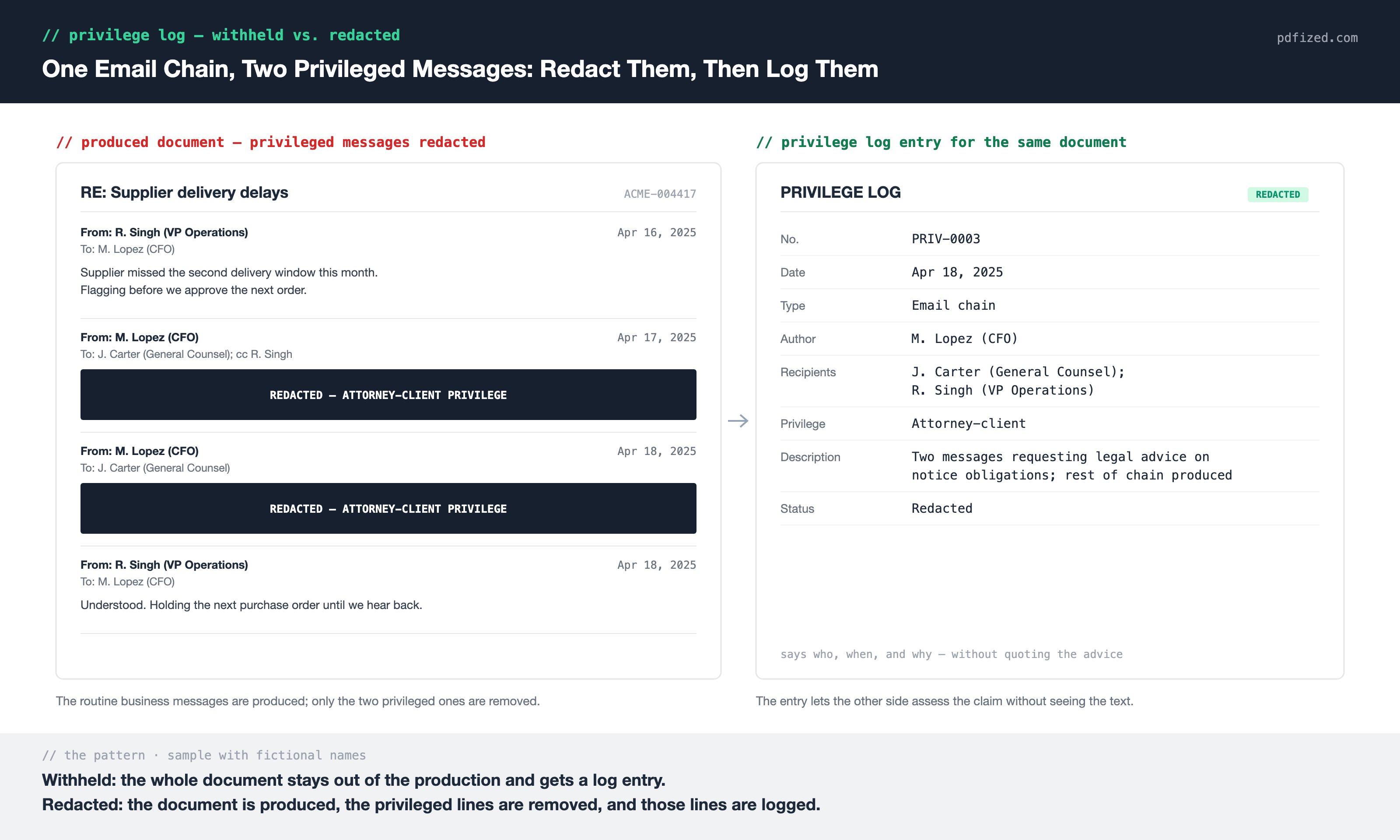
That redacted text is still information withheld on a claim of privilege, so the Rule 26(b)(5)(A) duty still applies to it. How redactions get recorded (on the main privilege log or on a separate redaction log) is usually settled by the parties' agreement or the court's order.
Then there’s the redaction itself. A black box drawn over text in a PDF editor leaves the words in the file, where anyone can copy them out. If that happens to privileged text, you're relying on a clawback under Rule 26(b)(5)(B) to fix it. Our guide on what happens if redaction fails shows how these leaks occur.
Proper redaction removes the text from the file, clears hidden metadata, and handles scanned pages through OCR. That is the job legal redaction software is built for, and our guide on how to redact legal documents walks through the steps.
What Happens If a Privilege Log Falls Short
The other side can challenge the log. It usually happens through asking the court to order the documents to be handed over. From there a court can:
- Order a more detailed log, as in the Triaxx case above
- Review the disputed documents itself, in camera
- Order the documents produced
- Treat the privilege as waived
It is also important to consider such things as timing. If you check the committee notes to the 2025 amendments, you will see that it warns that producing a log near the close of discovery can create serious problems. They suggest, without requiring, that you have to roll logs that follow each production.
Privilege Log Automation
To build a log by hand means that you have to copy dates, names, and file types from thousands of documents into a spreadsheet. But it is possible to automate most of that stuff:
- Metadata fields. Review platforms export date, author, recipients, and file type straight into log columns.
- Descriptions. Some eDiscovery tools now draft the privilege description for each entry with AI.
As for the privilege call itself, we cannot automate it. Whether a communication was made to get legal advice is a legal judgment, and an attorney still has to make it and stand behind it. PDFized doesn’t build privilege logs, but it can do this: it detects and permanently removes the text you've decided to redact, across scanned and digital PDFs, with every redaction logged so you can check it against your privilege log.
// faq
FAQ
Rule 26(b)(5)(A) says that if a party refuses to share docs because they’re legally protected, it must say so and explain what it is withholding. The rule doesn't specify how to do this, but a privilege log is the usual method.
There is no fixed deadline, even if we check Rule 26. Since December 2025, the parties must propose the timing in their discovery plan, and the court can set it in the scheduling order.
A log that groups similar documents and asserts privilege once per category, giving a date range, document types, participants, and the basis for the claim in place of one row per document.
If parts of a document are hidden because they’re legally protected, those parts still need to be accounted for. Whether they're listed in the main privilege log or a separate list depends on what both sides agree on and what the court orders.