
Redacted Military Documents: What Gets Blacked Out and Why
By PDFized TeamPublished on 8 min read
A redacted military document is an official defense record. In that record, certain details have been removed. The details include stuff like a service member’s Social Security number, a unit’s location, a source’s identity, or info that is still classified.
The document remains a valid record of what happened; the details that privacy law, operational security, or classification rules require to be withheld are gone from the released copy.
It’s crucial to say that military records are kind of at the intersection of three various protection regimes at the same time. Those regimes include stuff like personal privacy, operational security, and national security classification. So, it’s no wonder that a released defense file often carries more black ink than any other kind of public record.
What Does “Redacted” Mean on a Military Document?
The meaning of redacted is the same here as anywhere: some information was removed on purpose before the doc was released. What's different in the military niche is the reason why so much stuff is actually cut. A single investigation report can contain a service member’s SSN (privacy), the layout of a base (operational security), and intelligence sourcing (classification) – three removals, three different legal bases, one page.
If you’re somehow engaged in military and intelligence circles, you will 100% hear the same thing called a “sanitized” version. Yes, the word is different, but the process is the same: the released copy with the protected content removed.
Agencies typically mark each removal with the exemption behind it. On files released under the Freedom of Information Act, you’ll see notations like (b)(1) for information that is still properly classified, (b)(6) for personal privacy, and (b)(7) for law enforcement records – the same code system we break down in our guide to redacted government documents.
Why We Redact Military Documents
The reasons vary, but they are all linked to…
- Service member privacy. SSNs, DoD ID numbers, dates of birth, home addresses, and medical details are protected under the Privacy Act and FOIA’s privacy exemptions.
- Third-party protection. People like witnesses, complainants, family members, and others who were named in incident and investigation files.
- Operational security (OPSEC). Unit designations, troop strengths, movement details, capabilities, and facility layouts – information that stays sensitive even when the document itself is releasable.
- Classified material. Anything still classified under the governing executive order is withheld under FOIA’s first exemption, no matter how old the surrounding document is.
- Sources and methods. Informant identities and intelligence-gathering techniques are among the longest-protected categories – often withheld for decades after everything around them is released.
What We Redact on Common Military Records
If you check different military records, you’ll see they all seem to carry their own mix of sensitive details. That is why things that we redact depend on which document we are dealing with:
- DD-214 (Certificate of Release or Discharge). The SSN is the main target when a veteran shares it with an employer, lender, or landlord. When requesting a copy from the records center, you can also choose a “deleted” version that omits sensitive separation details such as the separation code and narrative reason.
- Personnel files (OMPF). SSNs repeated across decades of forms, medical entries, family member details, and disciplinary records.
- Incident and investigation reports. Witness and complainant identities, third-party names, and open-investigation material. By the way, we covered the same categories in our redacted police report guide, applied to military law enforcement.
- Medical records. Diagnoses, treatment notes, and mental health entries, protected the same way civilian health records are.
- Orders and award citations. Duty locations, unit movements, and operation names can stay OPSEC-sensitive long after the fact. Awards for bravery may also be released in the form when such details are removed.
- FOIA release packages. All of the above at once, plus OPSEC and classification review – which is why a released operations file can run pages of near-solid black.
Need to redact a military record?
PDFized finds and permanently removes SSNs, DoD ID numbers, and personal details from service records – free.
Redacted vs. Classified vs. Declassified
Usually people confuse those things. But you have to know the key distinctions with military files:
- Redacted – the document is released; specific content has been permanently removed from the released copy.
- Classified – the information is restricted under the national security classification system and is not releasable at all while that status holds.
- Declassified – the classification status has been lifted, usually after review. Crucially, declassified does not mean unredacted: a declassified document still goes through release review, and privacy, source, and residual-classification redactions are applied before the public sees it.
That's why famous declassified releases (the most famous thing is 100% the JFK assassination records) reached the public in stages over decades. But even in those docs, a lot of pages still have many black boxes long after the files were formally declassified. The pattern repeats elsewhere: the Senate’s 2014 report on CIA detention reached the public as a heavily redacted executive summary – cleared for release, yet dense with black bars protecting sources, methods, and identities. Court records work on yet another axis (sealing), which we cover in what redacted means in court.
Redacted Military Document Example: Before and After
Here’s what a released military record looks like next to the original piece. Some names and sensitive details are cut. But of course the main facts are there.
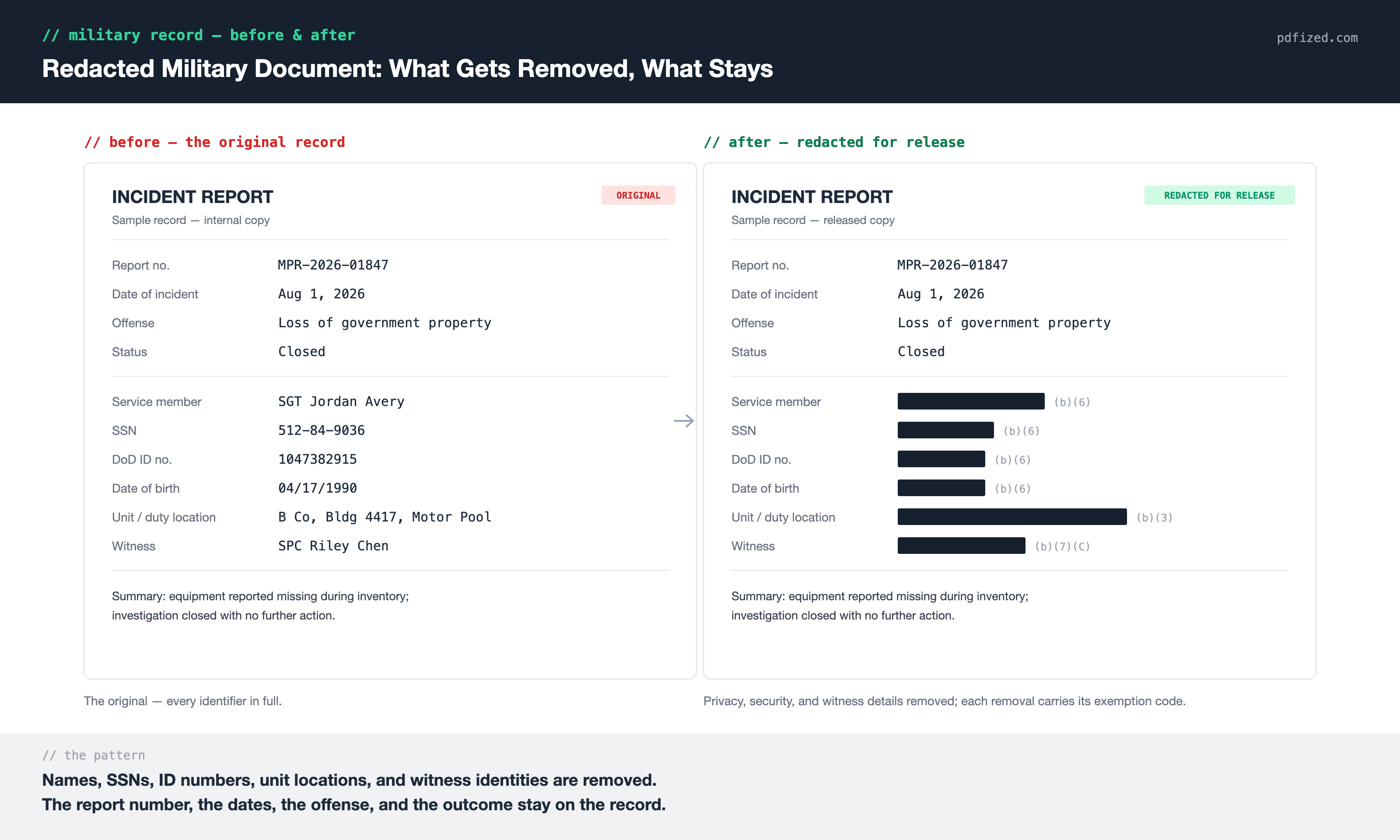
A heavily marked page is not automatically a cover-up. Most of the black ink on a released military file is routine: privacy redactions for the people named in it, and OPSEC redactions that would apply to any unit's paperwork.
Who Can See the Unredacted Version?
Redacted military documents are the default for outsiders. The amount of the black ink that you see depends on who's asking for the doc:
- The veteran (or their legal representative) can request their own records with far fewer removals – your own SSN and medical history aren’t withheld from you. Requests go through Standard Form 180 or the National Archives’ online request system.
- Next of kin of a deceased veteran can obtain substantially complete personnel records.
- The general public receives the redacted version until the records become archival. Military personnel records transfer to the National Archives 62 years after the service member's separation, at which point they open to public research.
- Those who request under FOIA get the parts of military files that can be shared. The response letter tells you what was released. “Granted in part” means some info was cut. The letter also explains why this or that info is gone and how you can appeal.
When It's Not Redaction: The 1973 Fire
One caution before assuming every gap in a military file is deliberate: a 1973 fire at the National Personnel Records Center in St. Louis destroyed an estimated 16–18 million official military personnel files – the bulk of Army records for personnel discharged between 1912 and 1960, and a large share of Air Force records from 1947 to 1964. If a requested file comes back incomplete from those eras, the missing pages were likely lost, not withheld. A redaction is marked and citable; fire loss is simply absence.
How to Redact Military Documents Yourself
Veterans and families share these records non-stop. Think a DD-214 for a job application or VA claim, service records for benefits, medical files between providers, and so on. The very moment you send the copy, the same rules that apply to the agency now become your rules:
- Work on a copy and keep the original intact.
- Find every instance. SSNs repeat across forms and decades of pages; automated detection catches the repeats a visual scan misses.
- Remove, don’t cover. A black box drawn over your SSN in a PDF viewer leaves the number in the file – the classic failure behind redactions that leak.
- Handle scans properly. Older service records are usually scanned images; the text has to be recognized by OCR before any tool can truly remove it.
- Strip the metadata. Scanned and converted records carry document properties and hidden data that survive visible redaction – clean them in the same pass.
- Verify. Try selecting and copying the blacked-out areas. Check the whole file and search the file for the removed numbers. Nothing should come back.
Organizations that have to deal with a gazillion defense records at volume (records offices, legal teams, contractors) use special military redaction software that they can 100% trust. That kind of software enables experts to apply the steps we talked about above automatically, with OCR, metadata scrubbing, and an audit trail built in.
// faq
FAQ
Because of three reasons: privacy law protects the people in the record, operational security protects units and capabilities, and classification protects national security material. Each removal is usually marked with its exemption code.
No. Declassification lifts the secrecy status, but the file still goes through release review. Privacy and source redactions are applied before publication. Many declassified files reach the public with portions still blacked out.
Largely, yes. Veterans and their legal representatives get their own records with far fewer removals, and next of kin of deceased veterans have similar access. Everyone else gets the redacted version.
They're FOIA exemption citations: (b)(1) means still classified, (b)(6) means personal privacy, (b)(7) means law enforcement records. The code tells you why something was removed – and whether appealing is worth it.
Yes, sometimes. Redactions related to investigations or classified information may be removed once a case is closed or the information is declassified. Personnel records can also become public 62 years after separation. Privacy redactions usually stay in place.