Redacted Government Documents: What They Are and Why
By PDFized TeamPublished on Updated on 8 min read
A redacted government document is an official record released with specific details permanently removed under a legal exemption – most often personal data, information about ongoing investigations, or national-security material.
Every year, millions of Americans request access to government records. Their goal is just one. They hope to see the inner workings of federal agencies, law enforcement investigations, or policy decisions. What they often receive instead are pages marked with black boxes – words, sentences, or entire paragraphs blacked out. These are redacted government documents, and understanding why they look the way they do requires understanding the legal, practical, and security-driven reasons behind the redaction process. New to the term? See what does redacted mean first.
This article breaks down what redaction is, the legal framework that governs it, the categories of information most commonly removed, and what the data tells us about how transparent – or opaque – government disclosure has become.
What Is a Redacted Government Document?
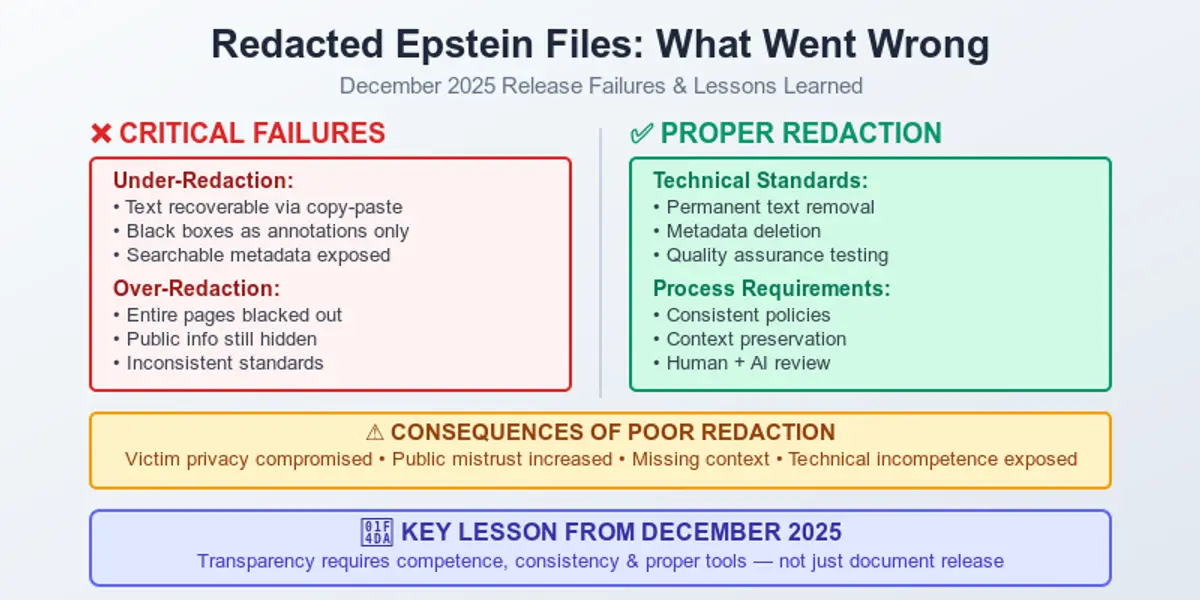
Redaction is the process of erasing different kinds of words, images, or sections from this or that doc for good, before it is released to the public. It’s not when you cover the text with a black bar in a PDF viewer (which can sometimes still be copied or extracted). Solid redaction deletes the underlying data for good, so as a result, nobody can recover it. This distinction matters: several high-profile leaks in recent years, including cases tied to major federal investigations, have resulted from "cosmetic" redactions where blacked-out text remained selectable or extractable underneath the visual cover – most notably the December 2025 Epstein files release, where some redactions could be defeated with a simple copy-paste.
Redacted government files are public records requested through formal channels, most commonly the Freedom of Information Act (FOIA), as well as state-level public records laws, court filings, and congressional document productions.
FOIA's Nine Exemptions: The Legal Framework
The law that makes all this possible is the Freedom of Information Act – FOIA for short, officially found at 5 U.S.C. § 552. It gives regular people the legal right to ask federal agencies for their records. Once you file a request, the agency's supposed to respond within 20 business days, though in practice they can (and often do) claim "unusual circumstances" to buy themselves more time.
From there, the agency goes hunting for anything relevant to your request, then reviews it all to figure out what's fair game to hand over – and what has to be held back or blacked out under one of FOIA's nine built-in exemptions.
These nine exemptions cover categories such as:
- Classified documents related to national defense or foreign policy
- Internal agency personnel rules and practices
- Information specifically exempted by other statutes
- Trade secrets and confidential business information
- Privileged inter-agency or intra-agency memoranda
- Personal privacy information (personnel, medical, and similar files)
- Law enforcement records that could interfere with proceedings
- Records related to the supervision of financial institutions
- Geological and geophysical data concerning wells
Many states have parallel laws (often called "sunshine laws") that apply similar logic to state and local government records, though the specific exemptions vary by jurisdiction.
How to Read the Exemption Codes on a Redacted Document
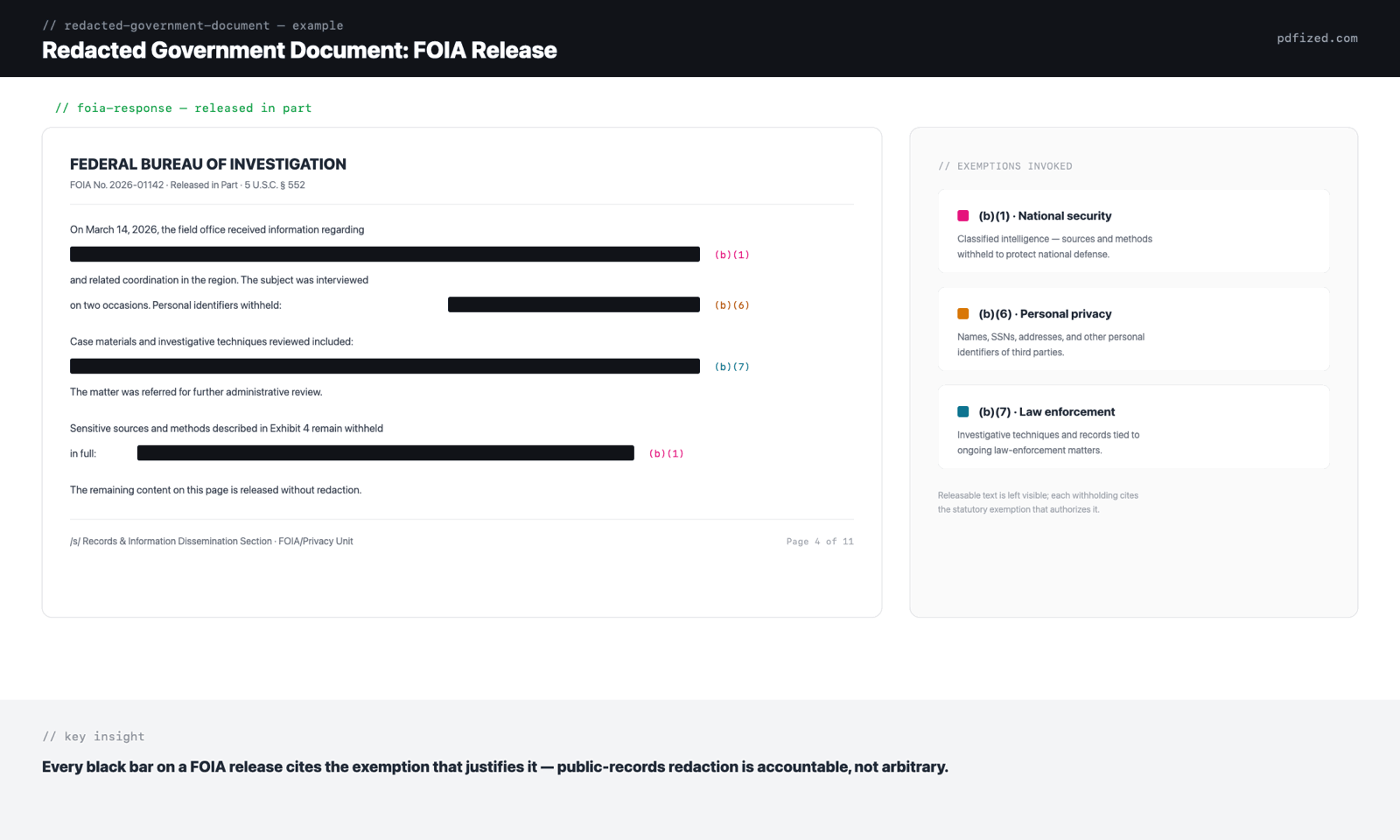
When a FOIA release comes back, each black bar usually carries a code identifying which exemption the agency invoked – "(b)(1)" for classified national security material, "(b)(6)" for personal privacy, "(b)(7)" for law enforcement records, and so on, following the exemption's position in 5 U.S.C. § 552(b). Two things to know when reading them: the same information should carry the same code throughout a response – a name redacted under (b)(6) on page one carries (b)(6) on page one hundred – and declassified historical records use a different marking system entirely, based on Executive Order classification categories rather than FOIA exemptions. Even after the 25-, 50-, and 75-year declassification milestones, material that would still harm personal privacy or national security stays blacked out.
Redacted Government Document Example: What a FOIA Release Looks Like
Here’s a typical page from a FOIA production – each black bar is labeled with the exemption the agency invoked to withhold it:
Redacting official records?
PDFized permanently removes exempt information before release – free.
Why Are Government Documents Redacted? 5 Reasons
There are several distinct reasons an agency redacts a document rather than releasing it in full:
1. National security
The most sensitive category covers classified material: military operations, intelligence sources and methods, diplomatic communications, and weapons programs. Disclosure here can endanger both people and ongoing operations, which is why Exemption 1 redactions are typically the least negotiable.
2. Personal privacy
A lot of documents end up with random personal stuff mixed in (Social Security numbers, medical details, home addresses, that kind of thing) belonging to everyday people who just happen to show up in the paperwork. Blacking that out protects those folks, since they're not who the request is actually about.
3. Ongoing investigations
Law enforcement and regulatory agencies often withhold details that could tip off suspects, compromise informants, or interfere with active cases.
4. Trade secrets and proprietary business data
When companies submit information to regulators, that data can include confidential formulas, financial figures, or negotiating positions that would cause competitive harm if disclosed.
5. Deliberative process
Internal agency drafts, recommendations, and pre-decisional discussions are often shielded so that officials can debate policy candidly before a final decision is made public.
Together, these categories are often referred to under the general umbrella of sensitive government information – a term covering anything from classified intelligence to a private citizen's medical file swept up in a larger investigation.
The Scale of the Problem: What FOIA Data Shows
The volume of confidential government documents processed each year has grown dramatically, and so has the share of material withheld or redacted.
- In Fiscal Year 2025, federal agencies received a record-setting 1,707,197 FOIA requests – a 13.7% increase over the previous fiscal year and the highest number ever recorded. Agencies processed 1,635,055 of them.
- This marks the third consecutive year that FOIA requests have reached seven figures, and the number of requests received has increased every year since fiscal year 2020.
- Despite dealing with processing more requests than ever before, full disclosure is still just an exception, not the rule. During fiscal year 2025, just 9.54% of processed FOIA requests were granted 100% fully. It means that most of the releases involved partial redaction or outright denial.
- Backlogs have grown alongside demand. Fiscal year 2024 marked the third consecutive year that backlogged cases topped 200,000, and in FY2025 agencies received 32,059 administrative appeals – a 59.38% jump over the prior year as requesters pushed back on denials and heavy redactions.
- Staffing has not kept pace with demand. According to the Justice Department's own FY2025 summary, just 4,823 full-time employees administer FOIA across the entire federal government, at an estimated cost of $661 million – meaning each employee is responsible for well over 300 requests a year.
These numbers illustrate a central tension in transparency policy: as public interest in public records grows, so does the administrative strain on the agencies responsible for reviewing and redacting them, which in turn increases both backlogs and the likelihood that release decisions default toward caution and heavier redaction.
The Push Toward Automation
Given the sheer volume of pages agencies must review line-by-line for exempted material, many agencies have begun adopting AI-assisted redaction tools. The ATF, for example, has credited automated redaction software with meaningful productivity gains in FOIA processing, and agencies like ARPA-H have explicitly sought AI tools to handle redaction and document review at scale. The pitch from people who back automated PDF redaction is pretty simple: let the software handle the boring, repetitive stuff (like spotting Social Security numbers or other personal identifiers) so it can turn a request that used to take weeks into one that takes hours – and free human reviewers for the judgment calls that genuinely require a human brain, like deciding whether a passage is sensitive enough to count as a national-security exemption.
At the same time, critics tend to say that automation comes with a bunch of risks – the question of whether AI redaction is safe enough for sensitive documents is far from settled. The latter usually include over-redaction of releasable material, under-redaction of sensitive data, and the same "cosmetic redaction" failures that have caused real-world leaks when automated tools mark text visually but fail to handle the underlying file. And that’s huge.
That gap is why agencies handling routine FOIA production increasingly move to dedicated public records redaction software rather than manual black-boxing: the tool decides whether the underlying data is actually destroyed, not the reviewer drawing the box.
Balancing Transparency and Security
Redaction exists at the intersection of two legitimate public interests: the public's right to oversee its government, and the government's obligation to protect national security, individual privacy, and the integrity of ongoing legal processes. Neither interest is absolute, which is why FOIA and similar laws build in structured exemptions rather than blanket secrecy or blanket disclosure.
For requesters, understanding these categories can make the redaction process less opaque. A document that comes back with entire pages blacked out is not necessarily evidence of concealment for its own sake – it may reflect a genuine legal exemption. But the process is far from an exact science. The National Security Archive has documented hundreds of "dubious secrets" – cases where censors blacked out documents that had already been released in full, or redacted entirely different parts of the same document at different times. In one example, four reviewers examined the same State Department memo on Rwanda over a 12-year period and reached four different conclusions: one withheld the final paragraph as classified (B1), a later reviewer released it but redacted a different section as privileged deliberation (B5), and a third release restored that section while deleting the final paragraph all over again. At the same time, the growing backlog and declining full-grant rate reflect real strain on the system, and have fueled ongoing debate among transparency advocates, journalists, and lawmakers about whether current practices strike the right balance.
Conclusion
To cut a long story short, redacted government documents are a routine and legally structured part of how the U.S. government balances transparency with security and privacy. Whether the underlying material involves classified documents tied to national defense or simply the private details of a citizen swept into an unrelated file, redaction serves a defined legal purpose under FOIA's nine exemptions. But as request volumes climb past 1.7 million a year and full-grant rates hover below 10%, the practical reality of redaction (its scale, its backlogs, and its increasing reliance on automated tools) is becoming as important a story as the underlying documents themselves.
// faq
FAQ
Yes. Every federal agency is required to offer an administrative appeals process if you believe info was withheld in an incorrect manner. Appeals have actually been popping up fast here and there in recent years, as more requesters push back on denials and heavy redactions. If the appeal doesn't resolve things, requesters can also take the matter to federal court.
There's no fee just to submit a request. But agencies can charge for the time spent searching for records and for making copies, depending on the type of requester and the scope of the request.
This happens when an agency uses cosmetic redaction, which means they visually cover text with a black box in a PDF. But the truth is that it happens without actually deleting the underlying data. The text is technically still there and can sometimes be copied or extracted. Several major leaks have happened this exact way, which is part of why agencies are moving toward proper redaction software instead of manual black-boxing.
Not exactly. FOIA only applies to federal agencies. Most states have their own public records laws (sometimes called "sunshine laws") that work on similar principles, but the specific exemptions, deadlines, and fees can vary quite a bit from state to state.
Technically, agencies have 20 business days to get back to you. But they can pull out the "unusual circumstances" excuse to buy more time, and honestly, a lot of them are drowning in backlogs anyway. When you've got over 1.7 million requests a year and only a small army of FOIA staff to actually work through them, long waits have basically become the default – unless your request is something dead simple.
Each code tells you which FOIA exemption was used for that black bar. (b)(1) means classified national security, (b)(6) means someone's personal privacy, (b)(7) means law enforcement records. Handy to know – the code tells you why something was hidden, and whether it's worth appealing. For how this plays out on one specific document type, see our breakdown of the redacted police report.