
Redacted Police Report: What Gets Blacked Out and Why
By PDFized TeamPublished on 8 min read
What Does “Redacted” Mean on a Police Report?
If it is the police report that gets redacted, it means that you have to cut some specific words, names, or entire sections from the doc before you send it somewhere. There’s a black bar, a white box, or a label such as "REDACTED" or an exemption code that appears over those words
The key word is removed. Proper redaction deletes the underlying data from the file, so the hidden text cannot be selected, searched, copied, or restored. That's very different from simply covering text with a black rectangle in a PDF editor – a mistake that has caused real leaks, because the "hidden" text often survives underneath the box. We break down how that goes wrong in our guide to what happens if redaction fails.
So a redacted police report isn't an edited or altered report. It's the same official record, minus the details the releasing agency is legally required – or permitted – to withhold. For the broader picture across every document type, see what redacted means.
Why Would a Police Report Be Redacted?
Here’s the thing about the police reports: they're public records in most jurisdictions, but they also have some extra-private info about people who never asked to be in them. Redaction is how agencies release the record without exposing the people inside it. The most common reasons:
- Protection of victims and witnesses. Names, addresses, and contact details of victims and witnesses are routinely withheld. It’s a must when it comes to issues like domestic violence, sexual offenses, or minors.
- Juvenile records. Nearly every jurisdiction shields the identities of minors, whether they appear as suspects, victims, or witnesses.
- Ongoing investigations. Details that could tip off a suspect, reveal investigative techniques, or compromise a case are removed until the matter is closed.
- Confidential informants. Anything that could identify a source is withheld – often permanently.
- Officer and third-party safety. Information that could reasonably put someone at risk of harm may be redacted.
- Medical and personal data. Injury descriptions, mental health details, Social Security numbers, and dates of birth fall under standard privacy protections.
At the federal level, these categories map onto FOIA's law enforcement exemption – 5 U.S.C. § 552(b)(7) – which allows withholding where release would interfere with proceedings, invade personal privacy, expose a confidential source, or endanger someone's life or safety. The U.S. The Supreme Court reinforced the privacy side of this in the DOJ v. Reporters Committee, holding that releasing law enforcement records about a private citizen to a third party categorically invades that person's privacy. State and local departments follow their own public records laws, but the logic is the same. For the broader picture of how agencies apply these exemptions, see our guide to redacted government documents.
Need to redact a police report?
PDFized detects and permanently removes victim, witness, and personal details for you – free.
What Information Is Redacted on a Police Report?
The exact list varies by state and by case type, but redactions cluster into a few predictable categories:
- Personal identifiers – names of victims, witnesses, and minors; dates of birth; Social Security and driver's license numbers. In other words, the standard categories of personally identifiable information.
- Contact details – home addresses, phone numbers, email addresses.
- Medical information – injury details, hospital records, mental health observations.
- Investigation details – informant identities, surveillance methods, evidence descriptions in open cases.
- Financial data – account numbers, card numbers, and similar details captured in fraud or theft reports.
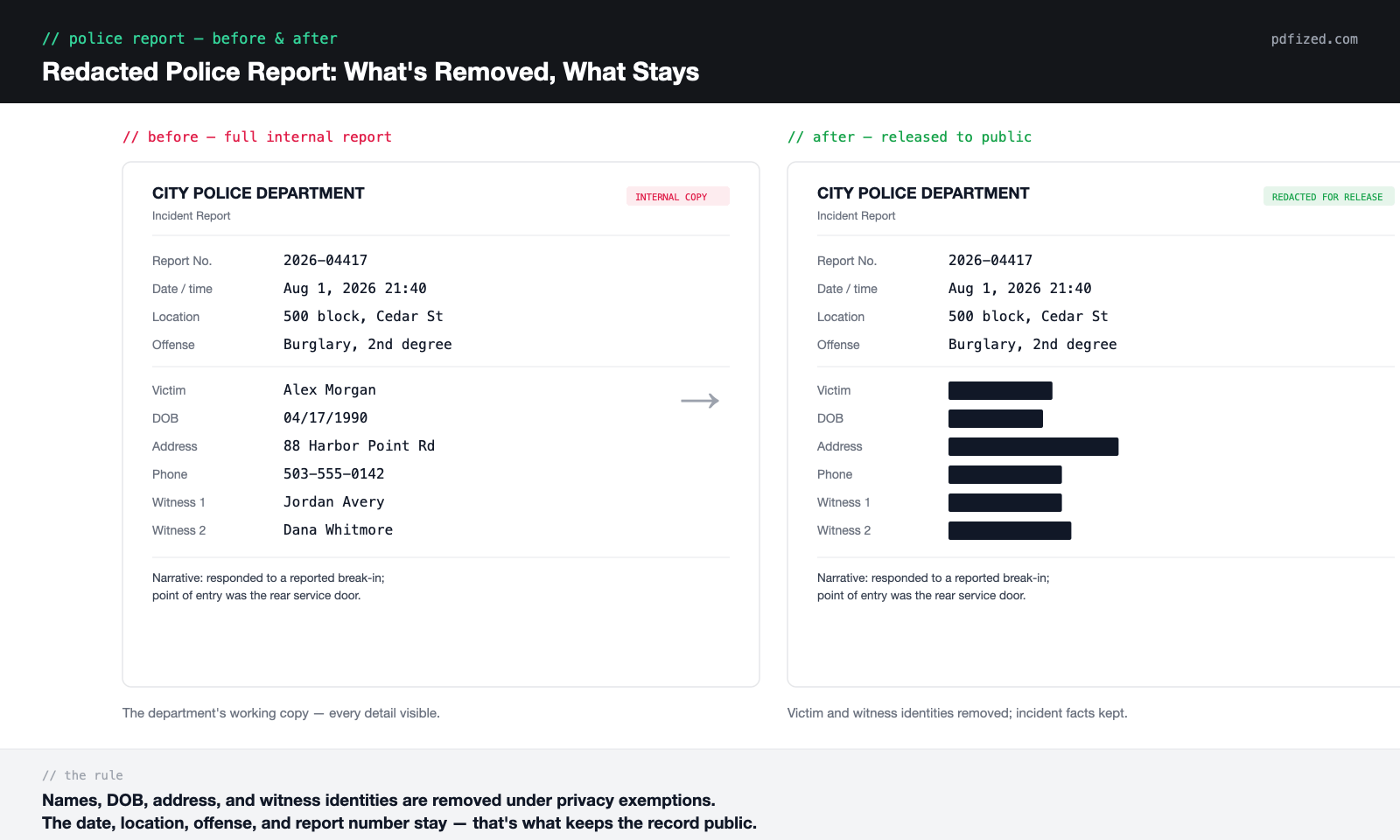
What generally stays visible: the incident date, time, and location, the general nature of the offense, the report number, and the responding agency – the facts that make the record usable for insurance claims, court filings, and background verification.
Redacted Police Report Example: Before and After
A properly redacted report keeps the incident facts intact while removing protected identities:
Who Redacts Police Reports (and Under What Rules)?
Redaction is handled by the releasing agency, not the requester – in practice, the police department's records unit, a county records custodian, or, for federal agencies, FOIA staff. A records officer reviews the report line by line, applies the exemptions their statute allows, and releases the rest.
Many agencies mark each removal with the legal exemption that justifies it, so a heavily marked page isn't automatically a cover-up – it's usually the paper trail of a legally structured review. If you believe something was withheld improperly, most public records laws give you the right to appeal the redactions.
How to Get a Copy of a Police Report – and Read Its Redactions
For local incidents, you request the report from the department's records division – typically online, by mail, or in person, with a small copying fee. Parties to the incident (the victim, a driver in a crash, the property owner) usually have an opportunity to check a fuller version than anyone else.
When you get the report, read the redactions (no need to fight them). Check out the exemption codes next to each black bar. They tell you why something was removed and whether an appeal is worth pursuing. A bar citing an open-investigation exemption may disappear once the case closes. It’s important to mention that a privacy-based redaction of a victim's identity almost never disappears.
How to Redact a Police Report Yourself
Insurers, attorneys, HR teams, and journalists regularly need to share police reports downstream – and the copy they hold may still contain details the next recipient has no right to see. If that's you, the rules from the agency side apply equally:
- Work from a copy, never the original file.
- Identify everything to remove – names, contact details, identifiers, medical information – before touching the document.
- Use real redaction, not drawing tools. Follow the full workflow in our guide on how to redact a PDF.
- Run OCR first if the report is a scan. Most police reports are scanned or photographed pages, which means the text lives inside an image – here's how to redact a scanned PDF properly.
- Verify before sharing – search for the redacted terms and try copying text from the blacked-out areas.
Law firms and investigators handling reports at volume typically rely on dedicated legal redaction software to detect and permanently remove protected details across entire case files, rather than reviewing page by page.
Conclusion
Redaction is what lets police reports stay public without turning the people in them into collateral damage. The black bars follow rules, not whims – and the same standard applies whether the redacting party is a records unit or a claims adjuster: the information has to be gone from the file, not hidden behind a box.
// faq
FAQ
Sometimes. Parties to the incident may be entitled to a less-redacted copy than the public version, and attorneys can obtain fuller versions through subpoenas or discovery. A fully unredacted copy of someone else's report is rarely available.
When it comes to public records law, victim identities are among the top protected categories. Thanks to the redaction, the victims are protected from things like retaliation, harassment, and unwanted exposure.
Generally yes, under state public records laws and, for federal agencies, FOIA – but with significant exemptions. What you receive is the releasable portion of the record, which is why redactions are so common.
It usually means the entire page fell under an exemption – most often an ongoing investigation or informant protection. It's worth re-requesting the record after the case closes, when some exemptions no longer apply.
Not if the redaction was done properly – the data is permanently removed from the file. But if someone only drew black boxes over the text, the content underneath can often be copied right out. That's the difference between redaction and covering.