How to Redact a CV: Protect Your Privacy Before Sharing It
By PDFized TeamPublished on Updated on 8 min read
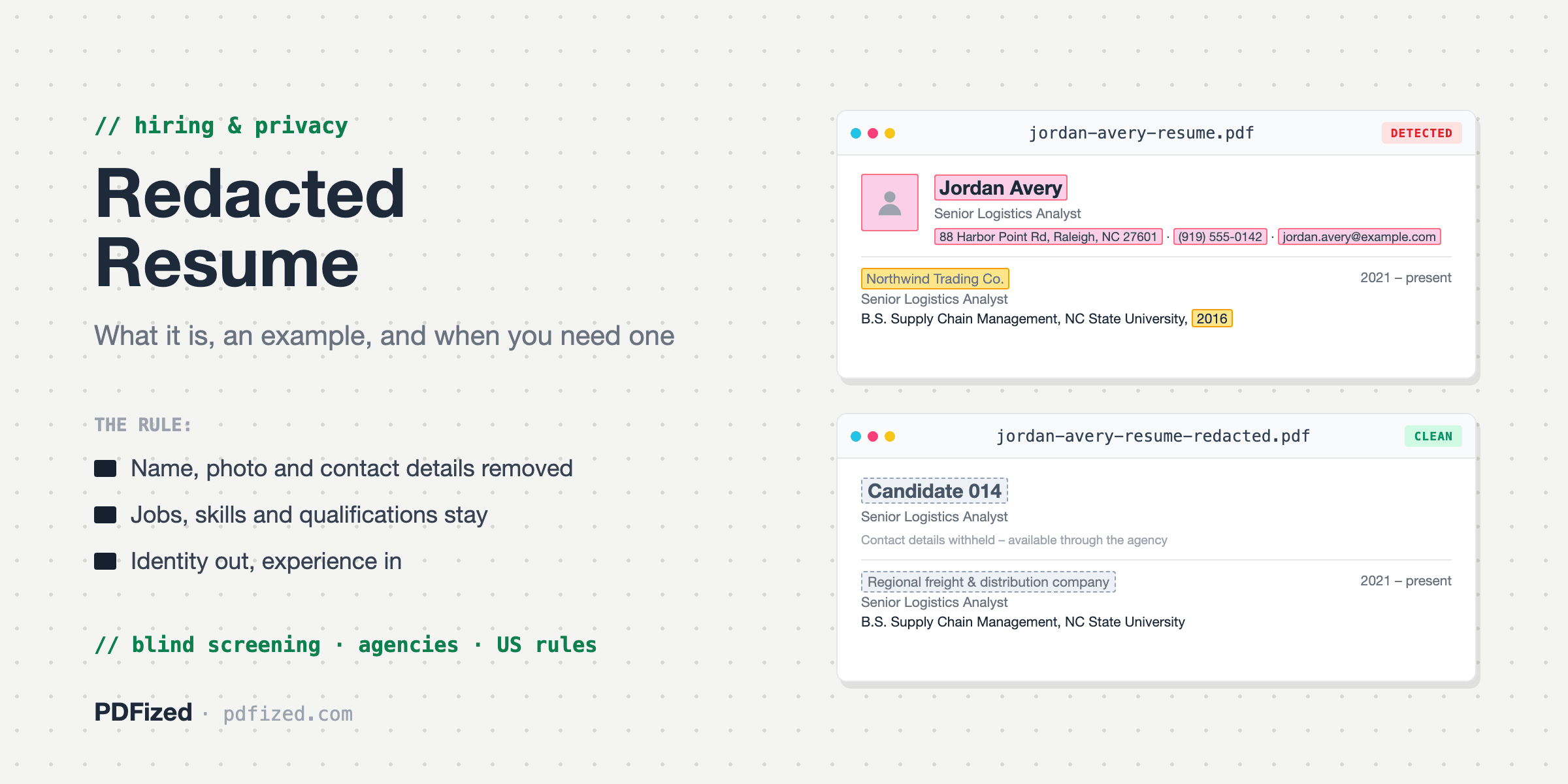
To redact a CV, remove the details that identify the candidate – name, photo, contact details, date of birth, and often school names – delete that text permanently rather than covering it, and strip the file's metadata before you share it.
Every CV is packed with personal details: your name, maybe a photo, your address, your date of birth, even the schools you went to – which can quietly hint at your age, background, or social class. Recruiters need some of this information to make a hiring decision, but not all of it, and definitely not forever. That's where redaction comes in: it means removing or hiding the parts of a CV that could put you at risk – either by exposing you to identity theft, or by triggering unconscious bias in the person reading it.
Below, we break down why redaction matters, what to remove in the process, how to do it like a pro, and the top errors that undermine the whole exercise.
Why CV Redaction Matters: Bias and Identity Theft
As a rule, CV redaction has one of two purposes. And it is better to separate them because they usually need slightly different approaches.
1. Reducing hiring bias
A large body of field research shows that identity cues on a CV measurably change how it's evaluated, independent of qualifications.
- One famous study by economists Marianne Bertrand and Sendhil Mullainathan, published through the National Bureau of Economic Research, tested this directly. Researchers sent out nearly 5,000 resumes that were 100% fake to real job postings. The point here is that they were changing nothing but the name at the top. Resumes with white-sounding names like "Emily" or "Greg" got about 50% more callbacks than the exact same resume with a Black-sounding name like "Lakisha" or "Jamal."
- In 2021, there was one more study. It was done by economists at UC Berkeley and the University of Chicago. Smart researchers found that resumes with Black-sounding names still got around 10% fewer callbacks than identical resumes with white-sounding names. The gap became much smaller over the years, but it definitely hasn't disappeared.
- Gender bias shows up too. Several studies on blind hiring found that the exact same resume is more likely to get a callback when it has a man's name on it instead of a woman's. And a PwC survey found that roughly one in five women say they've experienced gender discrimination during the hiring process.
- Performed by the Department for Work and Pensions, the UK government study tested this out directly. In 29% of cases, white applicants were those who were favored over ethnic-minority applicants. Plus, the study also showed that people with Indian-sounding names had to send out almost twice as many applications as individuals with white-sounding names simply to get the same number of callbacks.
- Time pressure compounds the problem: If we take a look at The Ladders research, we will see that the average recruiter spends only about six seconds on an initial CV scan. In other words, it is the process that is just long enough to register a name, a photo, an age, or a school, and not long enough to weigh actual qualifications.
Where identity cues are stripped out, the effect is real but uneven. A Swedish field study (Åslund & Skans, 2012) on anonymized applications found the interview-invitation rate for female candidates rose from 16% to 38% (matching the male rate) once names and other identifiers were hidden. Other studies are more cautious: Harvard Business Review–cited research found fully blind recruitment increased diversity by only about 4%, and one Yale-linked study even found a 7% drop in diversity in certain contexts, likely because reviewers filled the information gap with assumptions of their own. The honest summary from recent research is that blind CV screening works best as one part of a wider bias-mitigation process (pairing it with structured interviews and consistent scoring) rather than as a fix on its own.
2. Protecting people from identity theft and data exposure
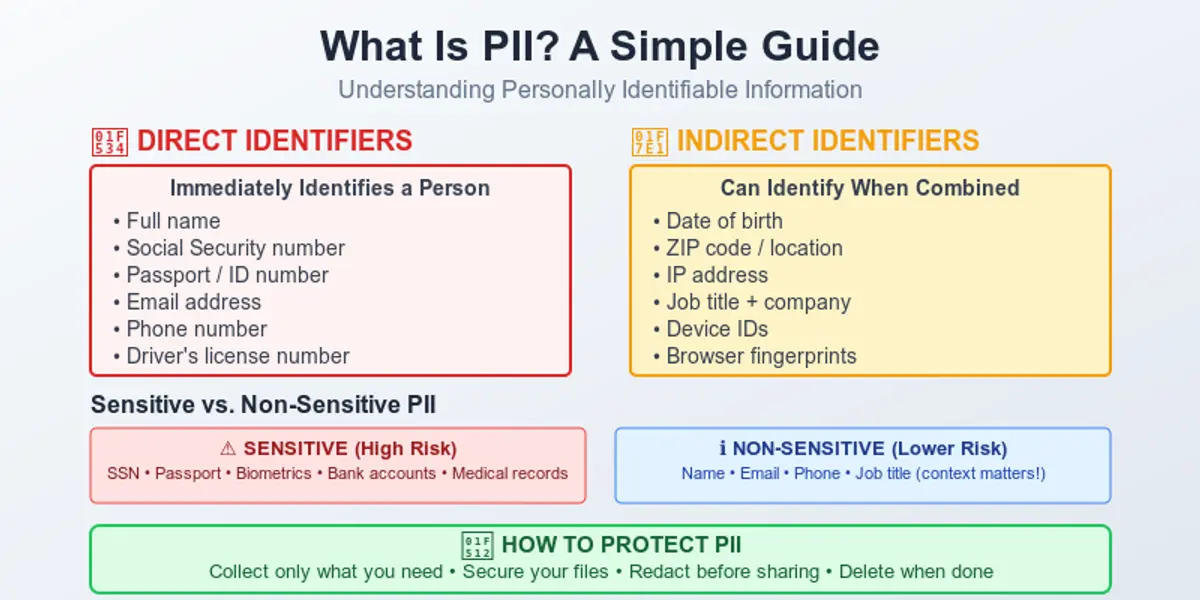
Here's the tricky part: without meaning to, your CV ends up being one of the richest single pages of personal information you'll ever hand over – your full name, phone number, home address, email, date of birth, education history, and sometimes even a signature or ID scan. Under GDPR this is data minimisation: share only what the recipient needs.
- This isn't just a theoretical risk. In mid-2025, security researchers at Cybernews found a badly secured cloud storage folder connected to LiveCareer, a resume-building website. More than 5.1 million resumes and CVs had been left exposed, some going back to 2016. Experts called it a "goldmine" for identity thieves and scammers. And it wasn't a one-off – a separate misconfigured storage container tied to applicant tracking system TalentHook exposed nearly 26 million resumes the same year.
- Experts in the field of identity theft routinely warn that a resume that has a Social Security number, the number of a driver's license, or date of birth should never be submitted. The point is that these fields have no legitimate hiring purpose and only add breach risk. Kroll Advisory Solutions' Brian Lapidus has put it plainly: this kind of data "should never appear on a resume."
- Cybersecurity firm Incogni's research describes a resume as, from an attacker's perspective, "everything an attacker needs" to run spear-phishing campaigns or build a fake identity – because it bundles full name, contact details, work history, and education in one place.
Sharing your CV?
PDFized removes names, contact details and other identifiers automatically – free.
What to Redact on a CV or Resume
Not every CV needs the same level of redaction – the most common redaction targets fall into a few tiers:
Standard redaction (nearly always removed for bias-reduction purposes):
- Full name (replace with a candidate ID or number)
- Photograph
- Gender pronouns and gendered titles (Mr./Ms./Mrs.)
- Age or date of birth
- Graduation year (a strong proxy for age)
- Contact details – email address, phone number, and personal website or LinkedIn URL (an email handle or profile link identifies a candidate as reliably as a name)
Context-dependent redaction (removed depending on role and risk):
- University or school name (can act as a socioeconomic and, in some regions, ethnic signal)
- Home address or postal code
- Marital status, nationality, religion
- Extracurricular activities or club memberships that can hint at social class or background
- Professional association memberships that may carry demographic signal
- Employer names that carry identity signal – a stint as an office administrator at a religious or community organization can trigger bias even when the duties are neutral; redact the organization's name, keep the title and duties
- Veteran status is a special case: the status itself is protected, but don't redact the military career experience – the roles and skills stay, only explicit status markers go
Always redact for data-protection purposes, regardless of bias considerations:
- National ID / Social Security number
- Driver's license number
- Bank account or payment details
- Full date of birth (a birth month/year is sometimes acceptable if age verification is legally required)
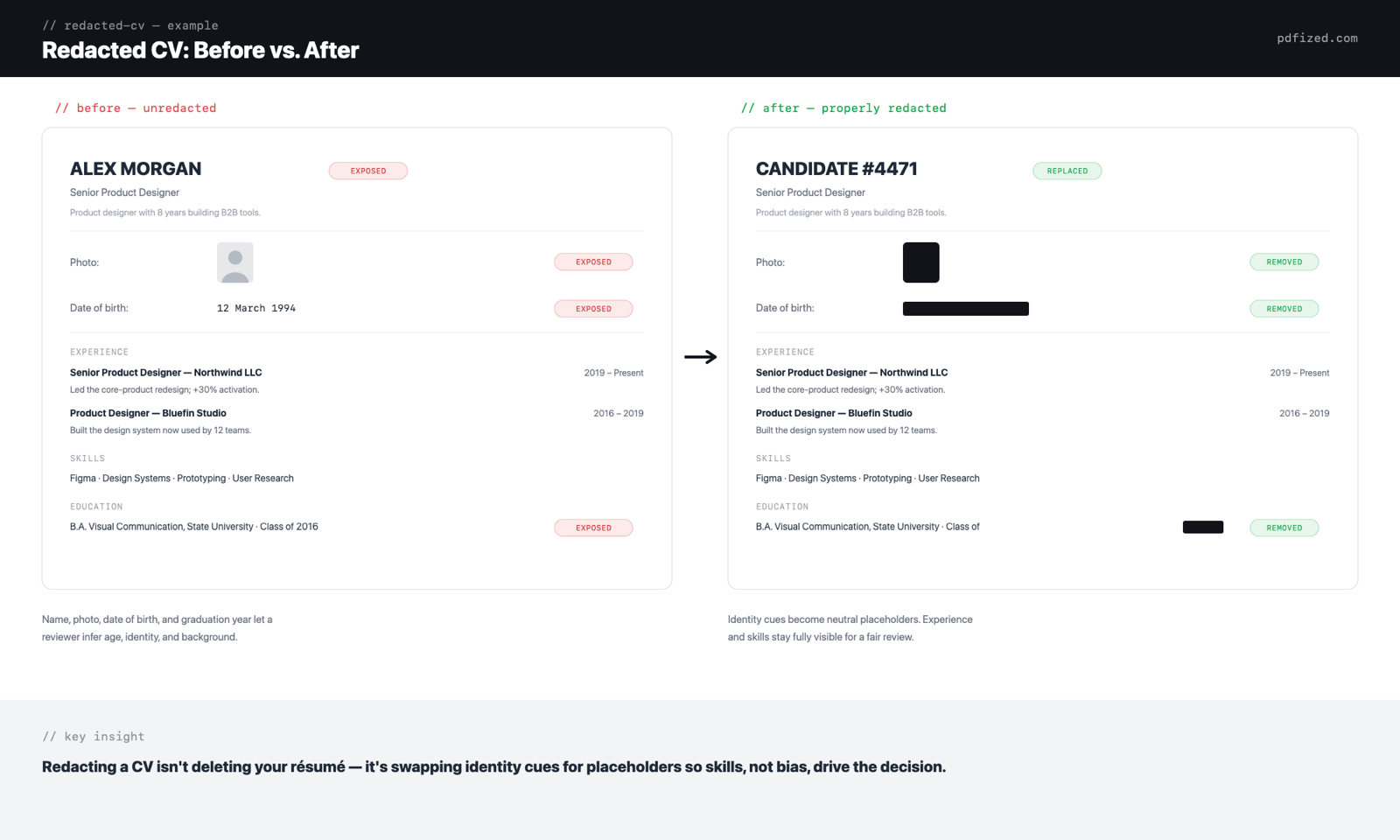
Redacted CV Example: Before and After
Here’s how those tiers look applied to a real CV – identity cues replaced with neutral placeholders, skills and experience left untouched: (For the US format, see what a redacted resume looks like.)
How to Redact a CV Properly
- Decide the scope before you start. Match the redaction level to the purpose. A CV being anonymized for an internal blind-screening trial needs different treatment than one being cleaned up before a candidate posts it to a public job board. Decide up front what's in scope so you're not making inconsistent calls document by document.
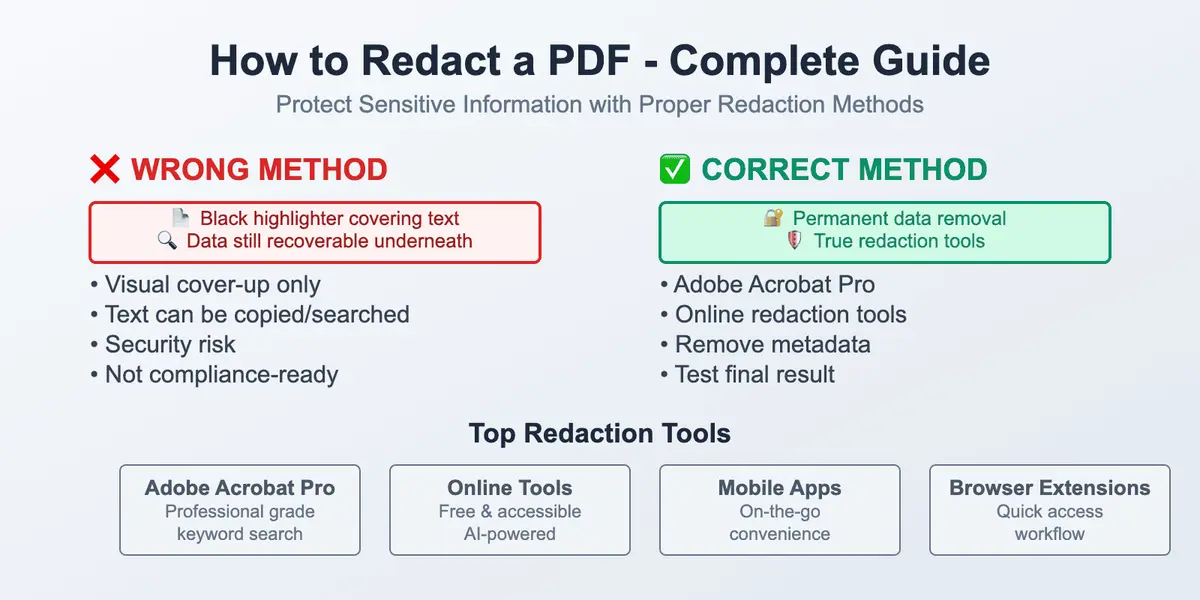
- Don't just cover text with a black box. This is the most common redaction mistake – and a serious one. Just slapping a black box, highlight, or strikethrough over text in a Word doc or PDF doesn't actually remove it – the text is usually still sitting there underneath. Anyone can choose it and bring it back. 100% complete redaction means the text is genuinely deleted from the file. In short, it is not just covered up so it seems to be hidden. If you're working with a PDF, use a CV redaction software that permanently removes the underlying text and image data – not just a drawing tool that paints over it.
- Replace, don't just delete, where structure matters. Simply deleting a name can leave an awkward blank or break formatting. Best practice (as used by anonymized-recruiting platforms) is to replace identifying details with a neutral placeholder ("Candidate 014" instead of a name, "University A" instead of a named institution) so the document still reads naturally and reviewers aren't distracted by obvious gaps.
- Check metadata, not just visible text. Both Word and PDF files are full of hidden metadata. The latter comprises author name, company, file path, sometimes tracked-changes history, and so on, that can simply show exactly what you just redacted from the visible page to the whole world. Strip document properties and inspect for embedded revision history before sharing the file.
- Have someone outside the hiring decision do it (or automate it). Manual redaction done by a person who will later see the same candidate again defeats the purpose. Doing this by hand takes about 5 minutes per CV. That's fine if you're only dealing with a handful, but it adds up fast – redacting 100 CVs manually could eat up around 8 hours of someone's day. For that reason, loads of companies choose to work with applicant tracking systems (like Taleo or Greenhouse) or dedicated anonymization software as an alternative. The best part is that it gets the job done in a more consistent manner. No need to count on one person's judgment every single time.
- Remember redaction is not a permanent fix – it is the first-pass tool. Blind screening only protects the initial review. Once a candidate reaches a phone screen or interview, identity becomes visible again, and bias can re-enter the process – which is why blind-screening workflows keep the unredacted original on file and unblind it only once a candidate advances. Pair CV redaction with structured interview questions and consistent scoring criteria if the underlying goal is fairer hiring outcomes overall – anonymizing the CV alone won't get you there.
CV Redaction Do's and Don'ts
| Do | Don't |
|---|---|
| Remove SSNs, ID numbers, and financial details entirely – always | Leave a Social Security number, birth date, or bank detail on a CV "just in case" |
| Replace identifying fields with neutral placeholders | Black out text with a highlight box that leaves selectable text underneath |
| Strip file metadata before sharing | Forget that tracked changes or author fields can undo your redaction |
| Have redaction done by someone outside the hiring decision, or automate it | Assume redacting the CV alone eliminates bias at every hiring stage |
The Bottom Line
CV redaction sits at the intersection of two real, well-documented problems: hiring decisions that are measurably swayed by a name or a photo in six seconds of screen time, and resumes that double as an identity thief's shopping list. Done properly – genuine deletion rather than cosmetic masking, consistent scope, and metadata scrubbed clean – redaction meaningfully reduces both risks. Done carelessly, with a black highlighter and no attention to what's hiding underneath, it protects no one.
// faq
FAQ
CV redaction is the process of removing or permanently hiding specific personal information, such as a name, address, or date of birth. Anonymization is the broader goal of making it impossible for reviewers to identify a candidate. Redaction is one of the most common strategies that help anonymize various details during the initial stages of recruitment.
Yes. But it usually depends on whether the employer actually accepts anonymous applications. You have to check it beforehand. Loads of companies tend to ask for blind CVs only, while others need your personal details in order to contact you or run background checks. So it's best to check the employer's application instructions first, rather than assuming it's fine to strip that information out.
No. CV redaction can reduce bias when it is time for the initial resume screening. But it doesn't cut off bias during the whole hiring process. When you are about to do the phone interviews or face-to-face meetings, your identity becomes known, so employers should combine blind screening with structured interviews and objective evaluation criteria.
Yes. A lot of applicant tracking systems and recruitment platforms can automatically strip out names, photos, addresses, and other identifying details from resumes before HR even looks at them. Doing this through automation also keeps the redaction consistent, even when you're dealing with hundreds or thousands of applications at once.
If you're posting your CV on a public job board or forum, it's worth stripping out sensitive details you don't actually need to share – things like your full home address, date of birth, ID numbers, or financial information. Recruiters really just need to see your skills and experience to evaluate you; they don't need enough personal data to steal your identity. The less you put out there, the safer you are.
Keep everything that shows what the candidate can do: job titles, duties, skills, work experience, and certifications. The goal is to hide who someone is, not what they've done.