
Redacted Resume: What It Is, an Example, and When You Need One
By PDFized TeamPublished on 8 min read
A copy of a resume that has no personal details (because they were taken out) is called a redacted resume. The name, photo, contact details, and date of birth are gone. Often the graduation years and school names go too. Everything about the work stays: the jobs, the skills, the qualifications. You can still see exactly what the person can do. You just can't tell who they are.
If you haven't come across one yet, you probably will soon. Staffing agencies send them to clients, and more and more US employers use them for the first round of screening. This guide covers what a redacted resume contains, who uses one and why, what it looks like, and what it can and can't fix. If everything above is not new for you, it means that you just need to make a resume. In that case, our guide on how to redact a CV helps.
{{inline-cta title="Need to anonymize a resume?" description="PDFized finds names, contact details, dates, and photos in a resume and removes them permanently – free."}}
Redacted Resume, Blind Resume, Anonymized Resume Are All the Same…or Not?
Kind of. In the US you'll hear all three, and HR people also say "blind screening". (Outside the US the same document is a "redacted CV" or a "name-blind CV".) They all mean one thing. Think resume in which the identity clues are stripped out before anyone reads it.
There's a small difference in what people mean by them. "Anonymized" and "blind" usually come up when the goal is fair hiring. Simply put, it's when the candidate is judged based on his or her own experience and nothing else. When we speak of "redacted", we mean the wider term that covers plain privacy: a resume that's going to a third party and simply shouldn't carry someone's phone number and home address. Either way, the details are removed, not covered up. That's what redacted means, and it's the most important thing to know about it.
Who Uses Redacted Resumes and Why
Employers running blind screening
The big reason is bias, and the evidence is hard to argue with. In the best-known US study, researchers sent identical resumes to employers in Boston and Chicago. Half carried white-sounding names, half Black-sounding names. The white-sounding names got 50% more callbacks (Bertrand and Mullainathan, NBER).
A much bigger follow-up sent over 83,000 fake applications to 108 of the largest US employers. Distinctively Black names cut the chance of a callback by 2.1 percentage points. In that story, most of that gap came from a small group of companies (Kline, Rose and Walters, 2022).
Blind screening is the obvious answer for the first look at a resume. If the name, photo, and age aren't on the page, they can't tip the decision.
Staffing agencies protecting their candidates – and their fee
Agencies and headhunters use blind resumes all the time for their own reasons. They provide the client a profile without the candidate's name and contact details. The client can judge the candidate but can't just skip the agency step and call the person directly. The redacted version is the sales pitch. Only when the client decides to do an interview, he or she receives the full resume.
Anyone sharing a resume beyond the hiring team
A resume is a neat little bundle of personally identifiable information: full name, address, phone, email, date of birth, sometimes a photo and a signature. The moment it goes beyond the people who actually need those details – a hiring panel, an outside assessor, a training dataset, a public portfolio – the identifiers should come out. Privacy law calls this data minimization: share only what the other side needs. Since 2023, California applies that rule to job applicants' data as well.
What a Redacted Resume Removes and What It Keeps
One question decides it: does this detail say what the candidate can do, or who the candidate is?
Removed:
- Name – usually swapped for a candidate ID or initials
- Photo
- Contact details – address, phone number, personal email, social links
- Date of birth and age – including the indirect clues, like graduation years
- Nationality, gender, marital status – rare on US resumes, common on resumes from abroad
- School and university names – in strict blind-screening programs, because they hint at background and class
- Current employer's name – in agency resumes, so the client can't work out who the candidate is
- Signature – if the resume is signed
- Hidden data – file metadata, comments, and tracked changes that still carry the name
Kept:
- Job titles, responsibilities, and achievements
- Years of experience and how long the person took each role
- Skills, certifications, and languages
- Degree level and field of study
- Location, at the level the job needs (city or region, not street address)
If everything was done correctly, it reads like a complete professional profile. It's just that there's a blank where the person used to be. If the reader can't tell what the candidate did, you redacted too much.
Redacted Resume Example: Before / After
Here's a before-and-after of a resume header and the first entries. The person is made up.
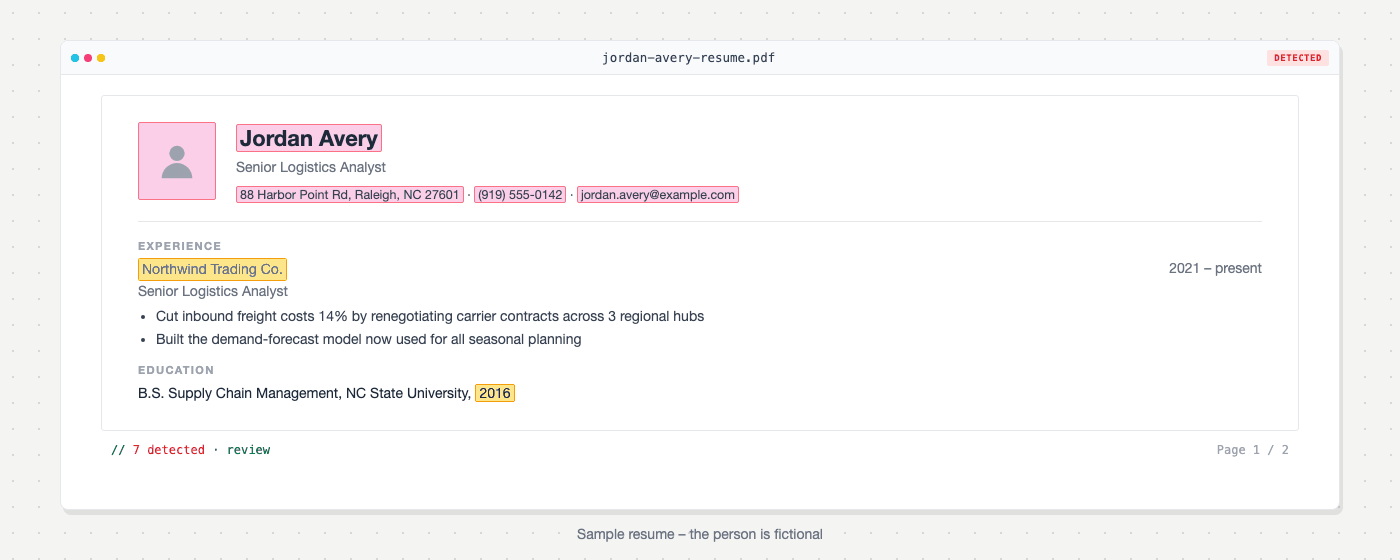
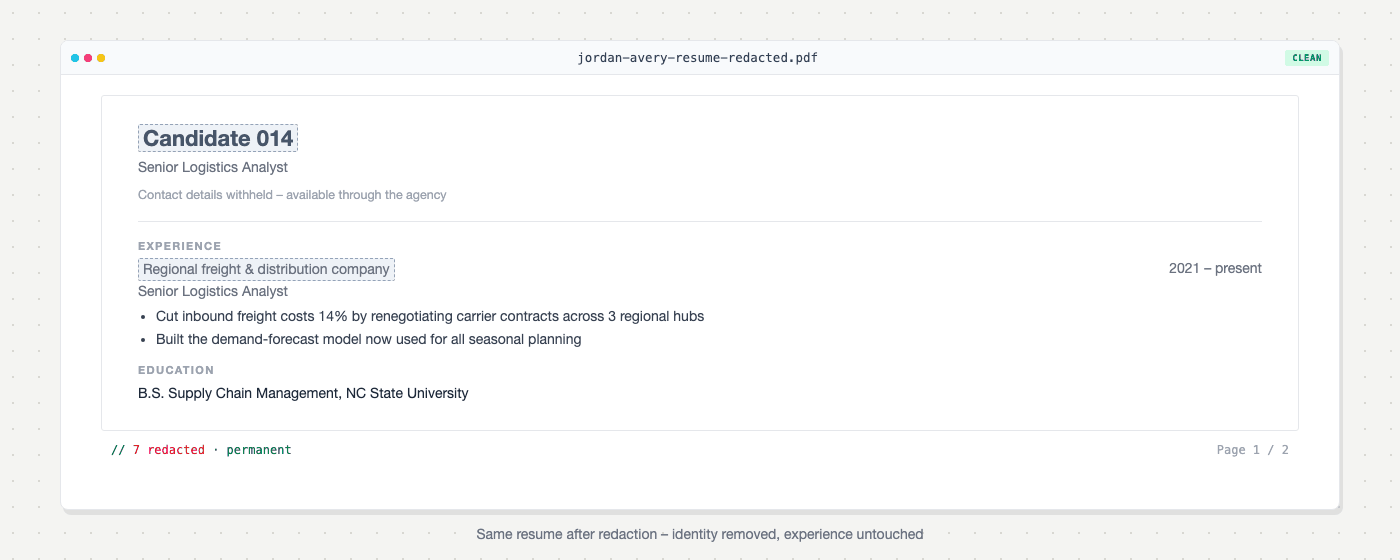
In the "after" version, the name has become "Candidate 014". The photo and the contact block are gone. The graduation year is out, and the current employer is described by industry instead of by name. Every bullet under every role is exactly as it was. A hiring manager can rank this candidate against the others. They just can't look them up.
Does Blind Hiring Actually Work?
Honest answer: it works for the first screening step, and only for that step.
Redacting a resume takes identity out of the decision about who gets an interview. It does nothing for the interview itself – the candidate's name, face, and voice are all in the room. So it only makes sense as one part of a process that also uses structured interviews and consistent scoring.
And there's a side effect worth knowing about. In the largest controlled test of blind shortlisting, the Australian government's behavioral economics unit had more than 2,100 public servants shortlist candidates with and without identifying details. Hiding the details didn't help women or minority candidates at all. Identifiable women were actually slightly more likely to be shortlisted (by 2.9%), because reviewers had been consciously giving them a push (BETA, 2017). Redaction removes whatever a reviewer was doing with the identity – bias against a candidate and bias in their favor alike. It's a tool for consistency, not a complete fairness policy.
For privacy – the other reason to redact – it's much simpler. A resume with no identifiers can't be used for identity theft and is far easier to share lawfully. That holds no matter what happens at the interview.
US Rules and Standards That Touch Resume Redaction
No federal or state law says you must use a redacted resume. But several rules nudge employers that way:
- Federal anti-discrimination law. Title VII bars hiring decisions based on race, color, religion, sex, or national origin, and the ADEA protects applicants aged 40 and over (EEOC). The EEOC's view on pre-employment questions is that asking about age or race isn't illegal by itself. However, it can be used as evidence of intent to discriminate. But if the employer can justify it, it's ok. Taking those details off the resume before anyone reads it is the easiest defense there is.
- State privacy law. On 1 January 2023 the CCPA/CPRA exemption for HR data expired. That's why California's privacy law now fully covers job applicants' data, including the data-minimization rule (Katten). An agency that forwards a full resume to a client is sharing more than the purpose needs.
- Salary-history bans. 22 states and 24 cities and counties bar employers from asking about past pay, according to HR Dive's tracker (updated April 2026). Redacting salary lines keeps the screening compliant wherever the candidate lives.
- Agency contracts. Many agency–client agreements say candidate profiles are shared in redacted form until the client confirms an interview.
Hiring internationally? The GDPR's data-minimization rule (Article 5(1)(c)) applies to any resume from an EU candidate, wherever the employer is based. And if you work in a regulated sector, treat the redacted resume as a privacy document, not an HR convenience: keep the unredacted original somewhere separate, and limit who can open it.
How a Redacted Resume Is Made
The short version: work on a copy, remove every identifier (including the ones hiding in the metadata), and check that the text under any black bar is really gone and not just covered. A resume "redacted" by drawing a box over the name in a PDF editor still contains the name. Anyone can copy it straight out.
The full process – which fields to look for, and the mistakes that expose candidates – is in the step-by-step guide linked at the top of this article. If you have to deal with resume redaction regularly (let's say, for an agency, an HR team, or a panel), use PDFized's resume redaction tool to find names, contact details, dates, and photos on its own and remove them for good. The best part is that the original is always kept separately.
// faq
FAQ
A copy of a resume in which the identifying info like name, photo, contact information, and date of birth are removed. At the same time, the experience and skills stay visible.
So the client judges the candidate on experience alone and can't contact them directly. The full resume follows once an interview is agreed.
In practice, yes. "Anonymized" or "blind" usually means the hiring-bias use case; "redacted" also covers privacy.
No – employers expect your name and contact details. Redact it only when you post it publicly or share it with someone who just needs your experience.
You have to keep in mind that the identity is taken from the first screening decision. However, it's not taken from the interview. It works best alongside structured interviews and consistent scoring.
Not if the text was actually deleted. If a black box was just drawn over the name in a PDF editor, often yes – so check the file before sending it.