What Does Redacted Mean? The Meaning of Redaction Explained
By PDFized TeamPublished on Updated on 8 min read
Redacted means that specific information in a document has been permanently removed before the document is shared or published – usually visible as black bars where the text used to be.
OK, let's say you open a doc like a government record or police report. There's something unusual on the pages. By the unusual, we mean black bars or marks reading "REDACTED" over some of the words or whole paragraphs. Simply put, somebody had removed some info on purpose before sharing it. No, it is not lost. Somebody deliberately reviewed the file and took some details out. Those details are the ones that law or policy requires them to withhold.
The word comes from the Latin redigere – to bring back, to reduce. In modern use, the redaction meaning is simple: editing a document to remove sensitive content while leaving the rest intact. The document you're holding is still an official, valid record. It's simply the public version of it.
What Do the Black Bars Actually Hide?
Redactions almost always cover a few predictable categories:
- Personal information – names, addresses, phone numbers, Social Security numbers, dates of birth
- Identities that need protection – victims, witnesses, minors, confidential informants
- Medical details – diagnoses, treatment notes, health record numbers
- Financial data – account numbers, card numbers, salaries
- Security-sensitive material – details of ongoing investigations, law enforcement techniques, operational information
- Legally privileged content – attorney-client communications, trade secrets
Only usable things remain visible: dates, case numbers, the general facts, the issuing agency. In other words, you know what happened. The fact known as who it happened to remains hidden because you don’t need it.
Redacted Document Example: Before and After
Here’s the redacted meaning on paper – the same record as the agency keeps it and as it reaches you, released in part with every removal labeled by its exemption:

Why Documents Get Redacted
We can't choose to redact or not redact. Two words only: legal obligation. Public records laws like the Freedom of Information Act require agencies to release documents on request. However, the same laws list exemptions: categories of information the agency must or may withhold. Privacy statutes point in the same direction – HIPAA for medical records, FERPA for education records, GDPR and state privacy laws for personal data generally.
So when we talk about redaction, working on a doc is usually the product of two competing duties. The first one is the duty to disclose the record. As for the other one, it is about protecting every person mentioned in the doc. Both duties kind of meet in the territory of black bars. The best part is that redaction helps to release the doc with all important info properly hidden. Without it, all documents would have to be 100% locked away.
Common Redacted Documents You'll Encounter
Redacted documents turn up anywhere records get released or shared – these are the types you’ll meet most often, and what typically gets removed from each:
- Police reports – victim and witness identities, juvenile names, and open-investigation details are removed before release. Full breakdown: redacted police report.
- Government and FOIA records – agencies mark each removal with the exemption that justifies it. See redacted government documents.
- Medical records – HIPAA defines 18 identifiers that must go before a record is shared. See redacted medical records.
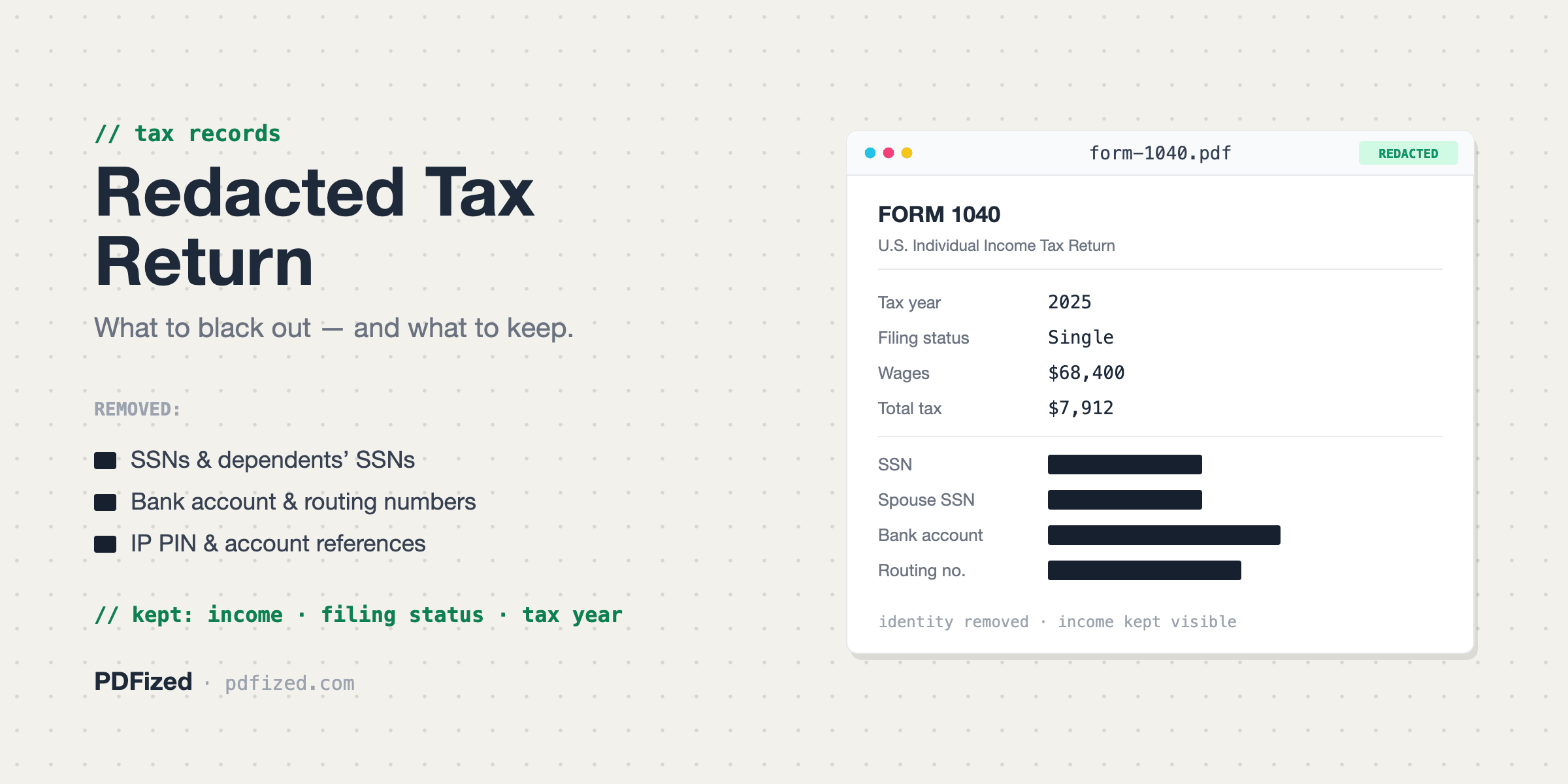
- Tax returns – SSNs, dependents’ details, and bank numbers are blacked out before a return goes to a landlord or lender. See redacted tax return.
- Bank statements – account numbers and balances are commonly removed before a statement is used as proof of income or address. See redacted bank statement.
- Invoices – bank details, client identity, and unit pricing come out before a copy goes to a lender, an auditor, or into a portfolio. See redacted invoice.
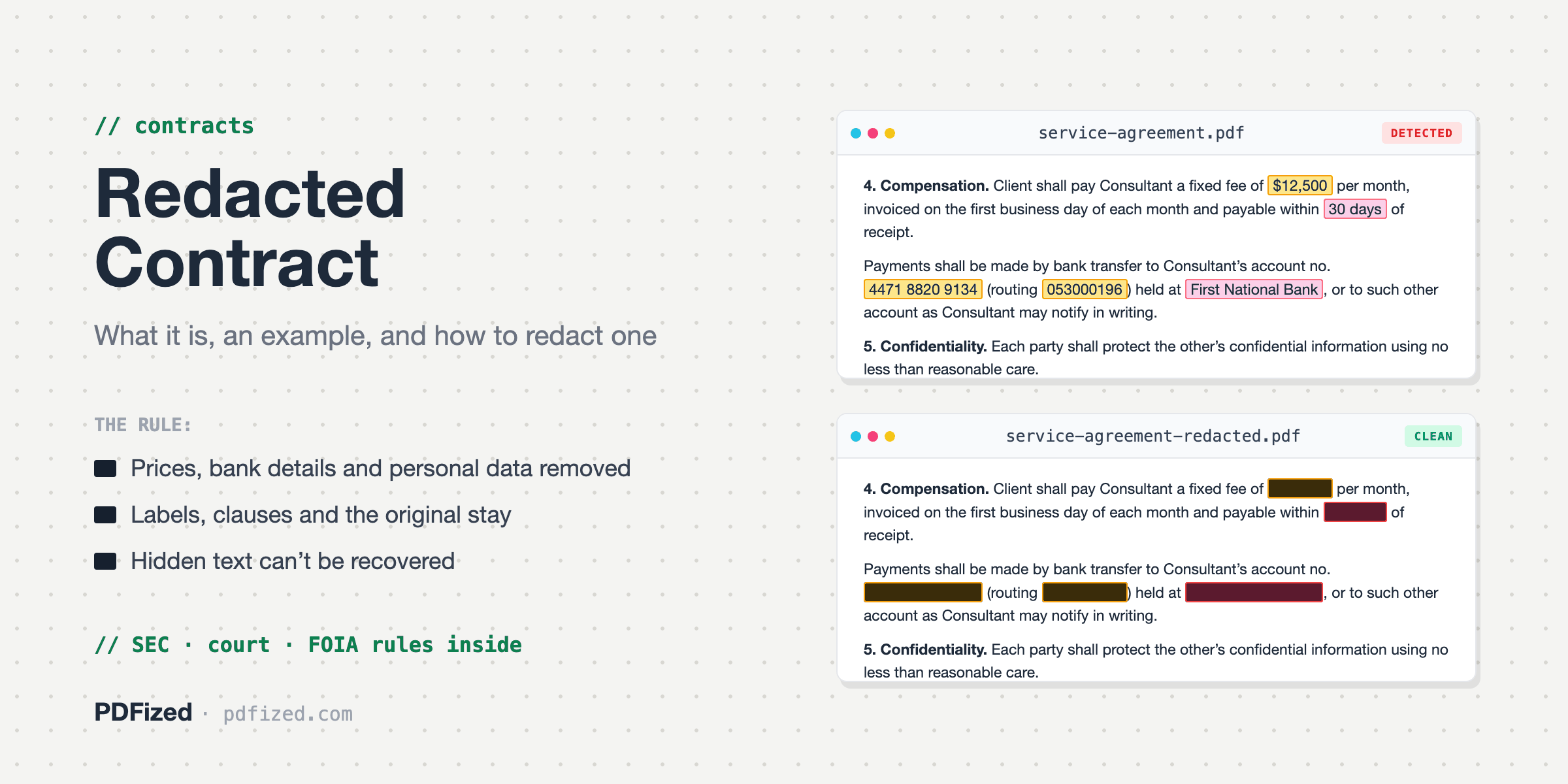
- Contracts and agreements – prices, bank details, and personal data are removed before a copy goes to auditors, investors, or a court. See redacted contract.
- Resumes – name, photo, contact details, and dates are removed before a candidate is screened or a profile goes to a client. See redacted resume. For the step-by-step version, see how to redact a CV.
- Military and defense records – service member PII, unit details, and operational information are withheld from released files. See redacted military documents.
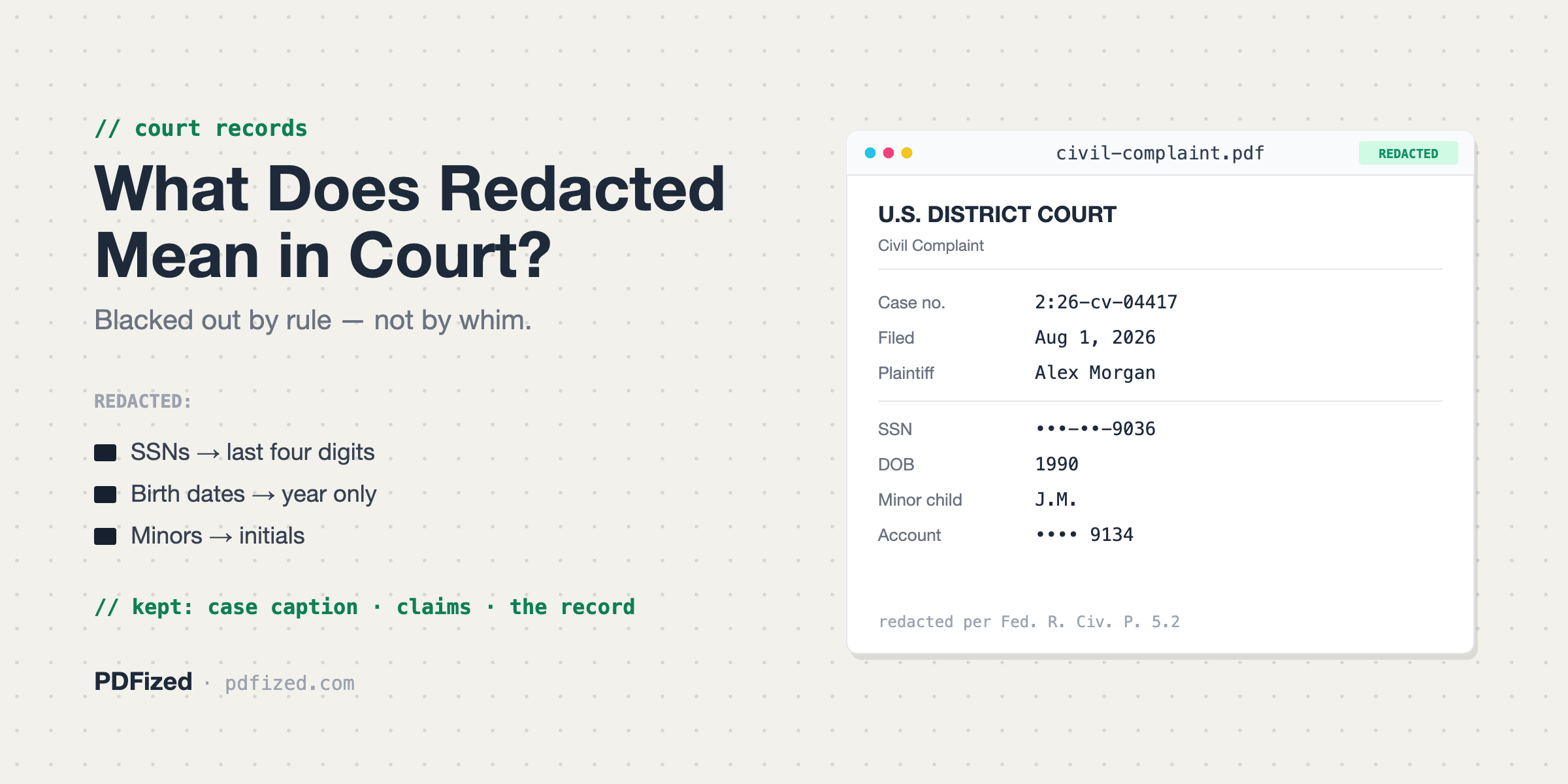
- Court filings – parties must redact Social Security numbers, minors’ names, and financial account numbers before filing. See what redacted means in court.
Redacted vs. Classified vs. Sealed
These get mixed up constantly, and they mean different things:
- Redacted – the document is released, with specific parts removed. You can read everything except the withheld details.
- Classified – the document (or information in it) is restricted by government security rules. It isn’t released at all until declassified – and when it finally is, it's often released with redactions.
- Sealed – a court has ordered the document withheld from the public record entirely. Nothing is released, redacted or otherwise.
In short: sealed means you can’t have it, classified means it’s protected by security rules, redacted means here it is – minus the protected parts. Of the three, the redacted meaning is the friendliest one: the document actually reaches you.
Redacted vs. Censored
People use both words , thinking the meaning behind them is the same. But that's wrong. Intent - that's what is different.
Redaction removes specific protected details from a document that still gets released. The target is a category of information. It can be something like a name, an account number, a home address, or anything similar. The meaning doesn't go anywhere from the doc, and the removal is visible. In other words, the user can see that something was taken out and usually s/he understands why.
Censorship, on the other hand, suppresses content. And the reason is simple: it's done because of what it says. The target is the message itself, not an identifier inside it. Users cut this or that passage because they want to stop people reading an idea, and the suppression is often not disclosed at all.
Here's a simple practical test. Ask what was taken out. If it's a detail that identifies some person or exposes that person to harm, you're dealing with redaction. If it's an opinion, a finding, or an inconvenient fact, censorship is in the game.
What Does Unredacted Mean? (And "Fully Redacted", and "In Part")
An unredacted document is the complete original – every detail visible, nothing removed. That's why courts and mortgage underwriters sometimes demand "the unredacted version", and why leaked unredacted files make headlines: they expose exactly the details the released copy was built to protect. A fully redacted page is the opposite extreme: the release obligation was met, but an exemption covered essentially everything on the page, leaving a wall of black. And a document released "in part" is the everyday middle ground – readable, with targeted removals. All three describe the same underlying process; they differ only in how much survived it.
Can You Unredact a Document?
If you did everything correctly, unredacting is just impossible. All stuff is deleted for good. But improper redaction is a different story, and it happens more often than you’d think. When someone draws a black rectangle over text in a PDF editor instead of actually removing it, the text survives underneath – and anyone can select, copy, and paste it right out of the file. Several high-profile releases have leaked exactly this way, including the Epstein files. We cover the well-known failures and their consequences in what happens if redaction fails.
Keep in mind that if you happen to receive a badly redacted document, using info someone wanted to hide can carry legal risk, especially with court records. It is easy to find a failure, but what really matters is what you do with that failure.
Need to redact a document properly?
PDFized permanently removes sensitive data – text, scans, and metadata – so there's nothing left to unredact. Free.
How to Read a Redacted Document
Some quick steps are described below:
- Look for exemption codes. Government agencies often label each redaction with the legal exemption behind it – a notation like "(b)(6)" next to a black bar means a FOIA personal-privacy exemption, while "(b)(7)" points to law enforcement records. The code tells you why something was removed and whether appealing is worth it.
- A heavily redacted page isn't automatically suspicious. It’s usually the paper trail of a legally structured review, not a cover-up. Privacy redactions (names, addresses, identifiers) account for most of the black ink.
- Some redactions expire. Details withheld because of an open investigation may be released once the case closes. Privacy-based redactions almost never are.
- You can often appeal. Public records laws typically give requesters a route to challenge redactions they believe are improper.
What If You Need to Redact a Document Yourself?
Well, stick to the standard that the agencies do: you do not just camouflage the info, you take it away for good. The full process, methods, and mistakes to avoid are in our guide on how to redact a PDF, and a dedicated PDF redaction tool will detect and permanently remove sensitive data automatically – including in scanned documents and hidden metadata.
// faq
FAQ
It means that before this or that doc was released, someone removed specific information from it for good. The black bars or “REDACTED” labels mark where that information used to be.
Redaction is the act itself: reviewing a document and permanently removing the sensitive parts before it's shared, filed, or published. "Redacted" describes the result – a document that has been through that process.
The redacted portions are deleted – permanently, from the file itself, if done correctly. The rest of the document remains intact and readable. The document as a whole still exists as an official record.
It means the removed content was personal information – typically names, contact details, or identification numbers – withheld under a privacy law or policy rather than for security or investigative reasons.
Data redaction is the same practice applied to datasets and structured records rather than single documents: sensitive fields – names, ID numbers, account details – are removed or replaced before the data is shared or analyzed. It's closely related to, but not the same as, masking; the difference is covered in data redaction vs. data masking.
Because disclosure laws usually don’t allow blanket refusal. If a record is subject to a public records request or a discovery obligation, the holder must release what they can and withhold only what an exemption covers. Redaction is the mechanism that makes partial release possible.
In everyday use, "black out" or "obscure". In publishing and law you'll also see "expurgate" and, loosely, "censor" – though censorship suppresses a message, while redaction removes identifying details from a document that still gets released.