Redacted Tax Return: What to Black Out Before Sharing
By PDFized TeamPublished on Updated on 8 min read
A redacted tax return is a copy of your return, but the main difference is that the most sensitive information is no longer there. It’s been 100% redacted. In other words, all the identifiers, such as Social Security numbers, bank account details, and dependents’ information, are gone, while anyone can still access your financial substance. You can share this doc with others far more safely because they now have proof of your income, yet they do not see your SSN or account numbers. More on what redacted actually means in our general guide.
It’s pretty dangerous to share the tax return doc with someone else. Here’s the thing: Form 1040 alone carries your full name, address, Social Security number, your spouse’s SSN, your dependents' SSNs, your signature, and the bank account and routing numbers where your refund lands. As you can see, it’s something any thief is dreaming about. The good news is that redaction will save you.
Who Asks for Your Tax Return – and Why
Tax returns are the standard evidence of income you get. So, it is no wonder that there are actually a lot of people who are quite curious to get one:
- Landlords and property managers. These seem to always look for proof of income for a rental application. Property teams handle this prep at scale with real estate redaction software.
- Mortgage and loan officers. They require your income verification for underwriting.
- Immigration filings. Tax returns or transcripts are a must when it comes to supporting an affidavit of support.
- Divorce and family court. Income disclosure is needed for support calculations.
- Business partners and buyers. This is what we call due diligence on a company’s finances.
- Accountants, advisors, and attorneys. Here, we are talking about the ongoing financial work.
As you can see, every one of those guys we mention above seems to want your income info. But the most important thing is that almost none of them need your dependents’ Social Security numbers or your bank routing number. That’s when redaction does its job: it closes the gap between what they need and what the doc contains. Business buyers doing due diligence usually ask for the paperwork behind the numbers as well, which is where redacted invoices come in.
What to Redact on a Tax Return
The specifics vary slightly by form, but the targets are consistent:
On Form 1040:
- Your Social Security number and your spouse’s SSN
- Dependents’ SSNs – these belong to children who can’t monitor their own credit for years, which makes them prime identity-theft targets
- Bank account and routing numbers in the refund section
- Your Identity Protection PIN, if you have one
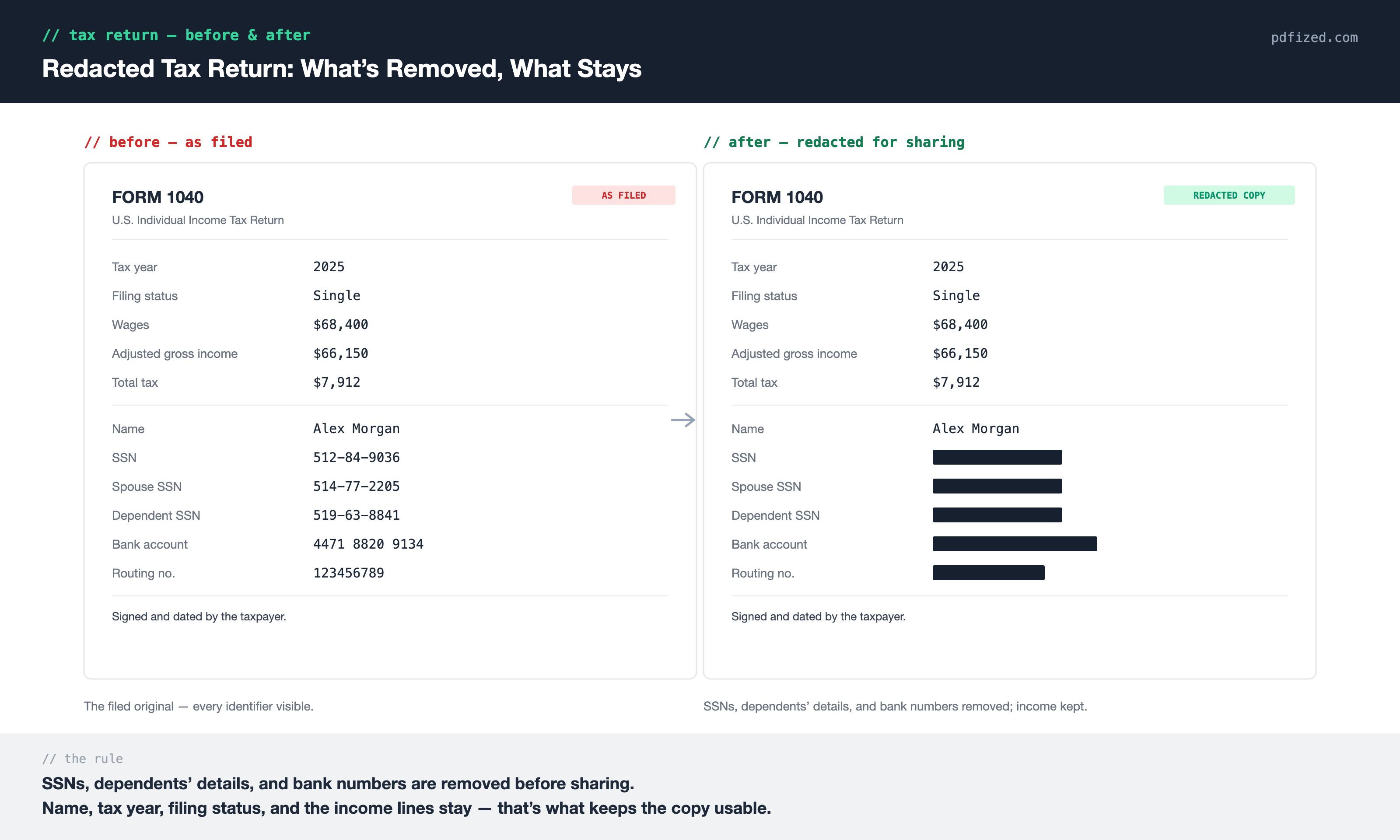
A redacted 1040 still shows your filing status, income lines, and refund amount – only the identifiers above are gone.
On a W-2:
- Your SSN
- Your employer’s EIN, if the recipient doesn’t need it
- Control numbers and account references
A redacted W-2 keeps your wages and withholding visible and hides your SSN – which is what employers and background-check companies expect when they ask for one.
On 1099 forms:
- Your SSN or taxpayer identification number
- The payer’s TIN, if not needed
- Account numbers
A redacted 1099 works the same way: the payment amounts stay, the taxpayer identification numbers go.
On any attachment or schedule:
- Repeated SSNs – they appear in the header of nearly every schedule, so check every page
- Account numbers on brokerage or interest statements
What to Keep Visible
If you fail with the redaction and just go too far, it’ll instantly stop proving anything. It doesn’t matter who you are going to send it to, just remember that generally they need to see:
- Your name and the tax year
- Filing status
- The income lines – wages, adjusted gross income, taxable income, total tax
- Employer or payer names
- Your signature and date, when the recipient requires a signed copy
The working rule: identity data goes, financial substance stays. If a number tells them how much, keep it. If a number tells them who you are to a computer system – SSN, account number, PIN – remove it.
Redacted Tax Return Example: Before and After
Here’s how those rules look on a real return – the same Form 1040 as filed and after proper redaction, with the identifiers gone and the income lines untouched:
Need to redact a tax return?
PDFized finds and permanently removes SSNs, account numbers, and dependents' details across every page and schedule – free.
When You Should NOT Redact
Now let’s see what you DO NOT redact:
- Mortgage lenders often require unredacted returns. Underwriting standards commonly require complete, unaltered documents, and lenders typically verify your return directly with the IRS anyway using a transcript request (Form 4506-C). If you still choose to redact, do not raise an eyebrow when you find out the file was rejected. Ask the loan officer before you black anything out.
- The IRS and state tax agencies must receive originals as filed – never redact anything you’re submitting to a tax authority.
- Court filings follow court rules, not preference. Federal rules (Rule 5.2), for example, require specific partial redactions – SSNs down to the last four digits, financial account numbers to the last four, minors to initials. Follow the rule exactly; both over- and under-redacting can get a filing bounced.
Does your recipient insist on the unredacted version? That’s O.K. for regulated processes. The protection comes from their legal requirements, not from your marker.
The IRS Alternative: A Masked Tax Transcript
Before you get the redaction job done, we’d like to inform you that the IRS has solved part of this problem for you. A tax return transcript (100% free through the IRS “Get Transcript” service!) comes partially camouflaged by default. In other words, users can see only the last four digits of SSNs and account numbers. As for the names, all are shortened. At the same time, users see all your money amounts.
If we speak about income verification, a transcript is often the better document: it proves what the IRS actually has on file, and the sensitive identifiers never appear in the first place. Many lenders and landlords accept transcripts, and the IRS provides a customer file number field so a lender can match the transcript to your application without your SSN. If the recipient accepts a transcript, no need to redact stuff.
How to Redact a Tax Return
If you do share the return itself, you know the rule now: we do not cover stuff, we remove it for good. Here’s how:
- Work on a copy. Never do anything to the original doc. Always have a copy!
- Find every instance. SSNs repeat on every schedule header; account numbers hide in the refund section and attachments. Go page by page. If that annoys you, let automated detection do the job in 1, 2, 3.
- Use real redaction, not drawing tools. A black rectangle drawn in a PDF viewer leaves the text underneath, where anyone can select and copy it. This is the single most common redaction failure – we’ve collected real examples of what happens if redaction fails.
- Handle scans correctly. A photographed or scanned return is an image – redaction tools can’t find text in it without OCR. Here’s how to redact a scanned PDF properly.
- Strip the metadata. PDF properties and hidden layers can carry your name and other details even after the visible content is clean.
- Verify before sending. Try selecting and copying the blacked-out areas. If text copies out, it isn’t redacted.
A dedicated PDF redaction tool automates the whole sequence – it detects SSNs, account numbers, and other identifiers across every page and schedule, removes them permanently, and cleans the metadata in the same pass. Teams that handle financial documents at volume use financial redaction software to apply the same standard across statements, returns, and reports.
Paper Returns: The Marker Question
If you work with a physical copy, do not hope for a black marker. It won’t save the day. After all, ink can be see-through at an angle, and a scanner often picks up what the eye misses. Instead, use a marker + photocopy: black out the details, photocopy the marked page, and share the photocopy. Shred the intermediate copy. Better yet, scan the original and redact it digitally, where the removal can be verified.
// faq
FAQ
Yes. A landlord is looking to see proof of your income. It usually includes stuff like name, tax year, and income lines. They do not need your Social Security number. Redacting SSNs, dependents’ details, and bank numbers on a rental application copy is standard practice. If the landlord runs a credit check, they'll collect your SSN through the application form, not your tax return.
Usually not. Underwriting generally requires complete, unaltered returns, and the lender verifies your income directly with the IRS through a transcript request. Ask before redacting – for mortgages, the answer is typically that you must provide the document as filed.
Yes – it’s your document and your data. The exceptions are submissions to tax authorities and courts: tax agencies need the return as filed, and courts have their own specific redaction rules you must follow exactly.
A redacted return is your own copy of the return with identifiers removed by you. A transcript is the IRS’s summary of your return, delivered already masked – last four digits of SSNs, shortened names, full money amounts. For income verification, a transcript is often simpler and safer, and many recipients accept it.
Not if everything you did was correct. The point here is that real redaction deletes 100% of the data from the file. Do not forget to also verify the redaction before you hit send.