Redacted Invoice with Examples and Tips
By PDFized TeamPublished on 8 min read
A redacted invoice is a copy of an invoice, but you won’t find any specific details in this doc. All of them have been removed for good before the invoice was shared. When we say “specific details,” we mean bank account numbers, personal data, or prices. But the most crucial thing here is that we don’t remove things that prove the invoice is real. The original invoice in your accounting system doesn't change. Only the copy you hand over does.
Invoices are more popular in everyday life than you think. Just think this: a gazillion of people, like auditors, lenders, landlords, insurers, courts, and many others ask for these docs sooner or later. But they don’t have to see everything. Check out the guide to know more.
What Do We Call a Redacted Invoice
When some pieces of information are removed from the shared copy, it means the doc was redacted. On an invoice, those pieces of information include an account number, a client’s home address, a unit price. The structure of the invoice (headings, line items, totals, dates) doesn’t go anywhere. In other words, the reader can still tell what the document is and what it says.
Two things a redacted invoice is not. It isn’t an edited invoice. If you change an amount, a date, or a party’s name, that's a different document, and in most places a misleading one. And it isn’t a “censored” version where the black bars are just drawn on top. If the text underneath is still in the file, anyone can copy it out, and the invoice is not redacted at all. For the general term, see our guide to redacted meaning.
Redacted Invoice Example
Here is what a properly redacted invoice looks like. The company, figures, and account details are invented for illustration.
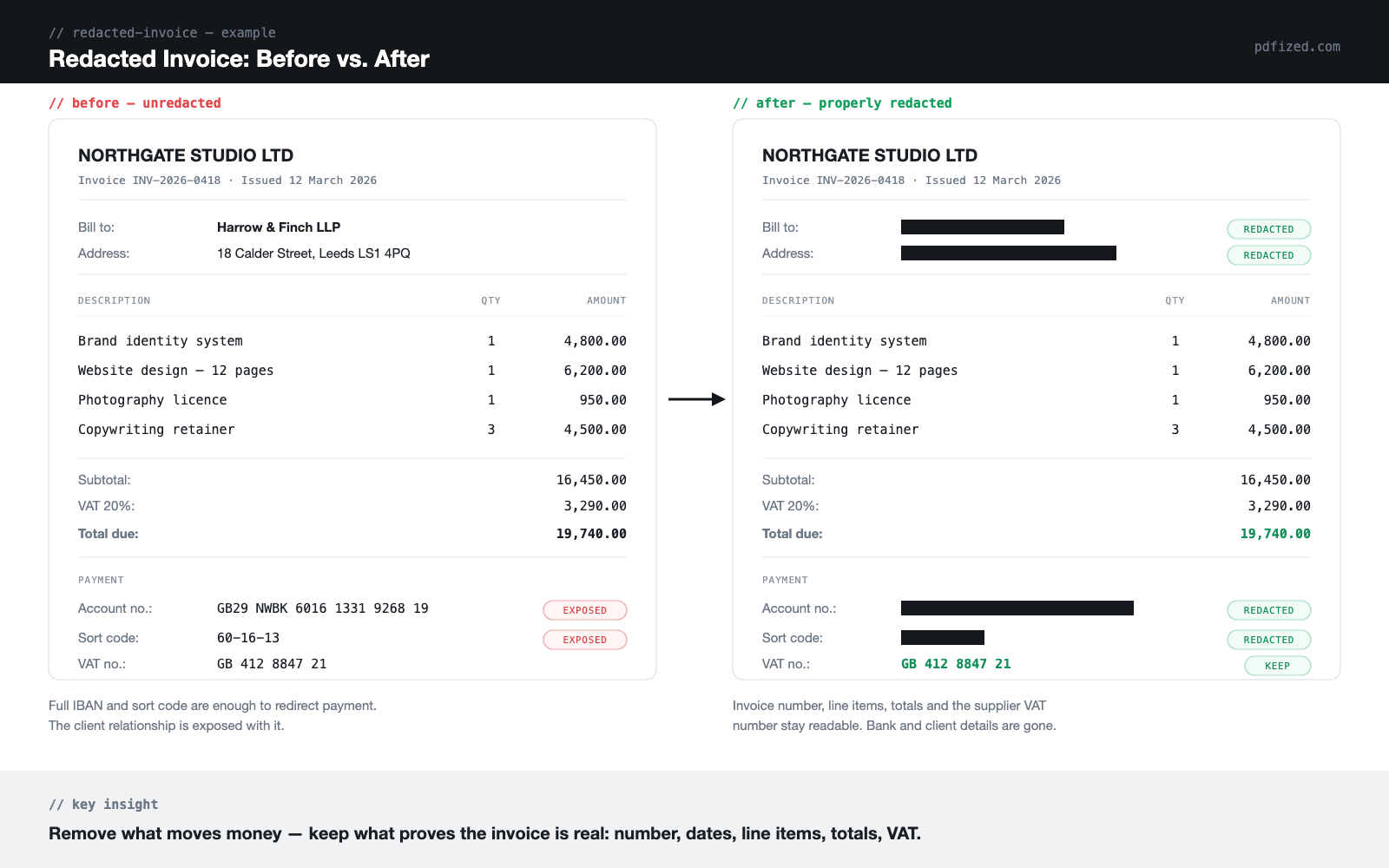
Notice what survives. The reader can see the invoice number, the issue date, what was delivered, and the total due. They can see that there is a payment block and that it names an account. They just can't read the account number. That's usually all a third party needs.
Need to redact an invoice?
PDFized finds account numbers, addresses and client details and removes them permanently – free to start.
When You Need a Redacted Invoice
| Situation | What usually gets hidden | Why |
|---|---|---|
| Sharing work samples or a portfolio | Client names, pricing, contact details | Client confidentiality, NDAs |
| Expense claims and reimbursement | Personal card or account details, unrelated line items | Only the claimed item matters |
| Loan, mortgage, or visa applications | Account numbers, other clients' details | Proof of income, not banking access |
| Tenders and public procurement | Pricing from other clients, trade terms | Commercial confidentiality |
| Court filings (US federal) | Full account numbers, SSNs, taxpayer IDs | Federal Rule of Civil Procedure 5.2 |
| Public records requests | Trade secrets, confidential commercial terms | FOIA Exemption 4 |
| Audits and due diligence | Personal data of employees or customers | Data minimisation under GDPR Art. 5(1)(c) |
Let’s focus on some.
Freelancers and agencies
Why we all redact invoices is not linked with law. A designer wants to show a prospective client what they billed on a similar project, or an agency needs to prove revenue to a lender. Of course, the invoice is the evidence. However, the identity of the client and the exact rate are nobody else's business. Redaction lets you share the proof without leaking the relationship.
Expense and reimbursement
When employees in the office have to forward receipts and invoices for reimbursement, unfortunately, they tend to send far more than needed. For example, many employees send a full statement with other purchases on it, or a personal card number in the footer. But it is much safer for an employee (and much cleaner for finance) to use a redacted copy showing just the claimed item, the date, the vendor, and the amount, and nothing else.
Court filings
If an invoice ends up as an exhibit in a US federal case, Rule 5.2(a) applies. Financial account numbers are cut to the last four digits, Social Security and taxpayer numbers to the last four, and birth dates to the year. State courts have similar rules. Our guide on redacting legal documents covers the wider process.
Public records
Invoices paid by government agencies can be requested under FOIA. Exemption 4 protects trade secrets and confidential commercial or financial information obtained from a business. If your pricing with an agency is confidential, the agency redacts it before release.
What Do You Redact on an Invoice?
…anything that someone else may use to move money, identify you or anyone else, etc.
- Payment details: bank account numbers, IBAN, SWIFT/BIC, routing numbers, and so on.
- Personal data: home addresses, personal phone numbers and emails, dates of birth, national ID, and so on.
- Pricing: unit rates, discounts, and payment terms if you have to share an invoice outside the deal.
- Tax identifiers: VAT numbers and tax IDs when the recipient doesn’t need them at all.
- Signatures: a handwritten signature in a shared file is easy to lift.
- Hidden content: PDF metadata, comments, and the original file name (because you see client's name there, as a rule).
The most important are payment details. They are because invoice fraud is one of the most expensive crimes that people face in the niche of business. If you take a look at the FBI’s Internet Crime Complaint Center, you will see that business email compromise (it’s the scam category that includes fake and altered invoices) generated about $3.05 billion in reported US losses. This info comes from more than 24,768 complaints in 2025. A leaked set of real bank details is exactly what those scams are built on.
Things that should be visible
A redacted invoice still has to work as an invoice. Keep:
- the invoice number and issue date,
- the supplier's business name,
- line item descriptions and quantities,
- subtotal, tax, and total,
- the payment status or due date, if that's what the reader needs.
Is the invoice used for tax or VAT purposes? If yes, you have to be very careful. In the EU, Article 226 of the VAT Directive provides users with all the details an invoice must have. They include a sequential invoice number, the supplier’s VAT identification number, the date of issue, and the VAT rate and amount. If all are redacted, your invoice is not a valid VAT invoice anymore.
Some problems come with over-redaction. Half its lines blacked out will 100% cause many questions about what you’re hiding. That’s why such an invoice often gets rejected. This, in turn, costs more time than redacting carefully the first time.
Redaction of an Invoice
To redact an invoice, work on a copy. Mark every sensitive “ingredient”, use a redaction instrument to remove the text for good, clear the hidden data, and verify the result.
- Export a copy. Make sure that the original of your document is still in your accounting system. Export the invoice as a PDF and redact that.
- Decide who it’s for. Use the table above. The purpose decides what goes and what stays.
- Mark every sensitive value. Check the header, footer, payment block, and any notes field. As a rule, you can see account details repeating in the footer of every page.
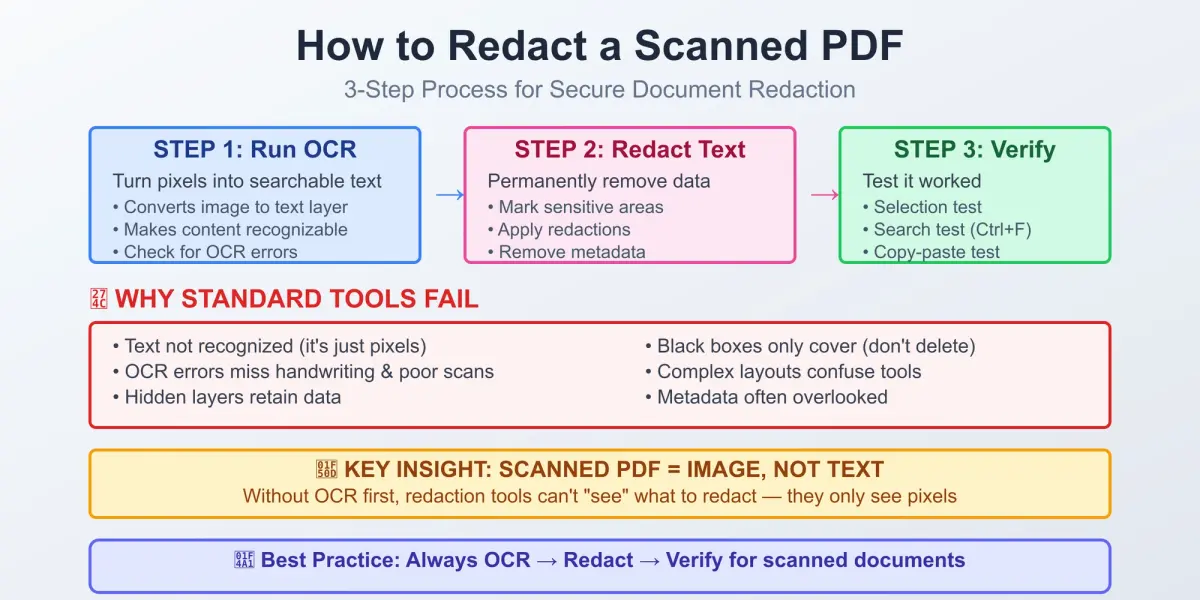
- Apply permanent redaction. Use a tool that deletes the underlying text, not one that draws a shape over it. If the invoice is a scan or a photo of a paper invoice, run OCR first; see how to redact a scanned PDF.
- Clear hidden data. Remove metadata from the PDF and rename the file if the name reveals the client.
- Verify. Search the file for a redacted number. Try to copy text from under a bar. Open the document properties.
- Mark it as redacted. A line such as “Redacted copy, account details removed” tells the reader what they're looking at and stops anyone treating it as the full invoice.
PDFized handles steps 3 to 5 for you. Upload the invoice in your browser and our free financial redaction software detects account numbers, addresses, and other sensitive fields and removes them permanently, including on scanned invoices after OCR. The original is kept separately from the redacted version. Whatever tool you use, review the pricing yourself. Only you know which rates are confidential in a given deal.
For the general methods, read how to redact a PDF.
Mistakes That Expose Redacted Invoices
- A black box over live text. The most common failure. The bar looks solid, but a reader selects the area, copies, pastes, and gets the account number. We cover the consequences in what happens if redaction fails.
- Redacting the body and forgetting the footer. Many invoice templates print bank details at the bottom of every page.
- Leaving the file name alone. “Invoice_AcmeCorp_March.pdf” undoes the redaction of Acme's name inside the file.
- Editing instead of redacting. Changing a figure to hide it creates a document that no longer matches your records. Redact it, don’t alter it.
- Sharing the redacted copy over an open channel. A clean file sent to the wrong address is still a leak. Send it the way you’d send any sensitive document; see how to send secure PDF files.
// faq
FAQ
It means a copy of an invoice with specific details permanently removed, usually bank details, personal data, or pricing, so the rest can be shared safely. The original is unchanged.
As proof that a transaction happened, yes. As a tax or VAT invoice, only if the legally required fields are still visible. Check what the recipient actually needs before you redact.
You can, but there is rarely a reason to. Your accountant needs the full document to do their job. Redaction is for third parties who need proof, not for the people who process the invoice.
Yes. Redacting a copy for sharing is normal practice. What’s not acceptable is altering the figures or the parties on a document you present as genuine.
If the “redaction” was a shape or highlight drawn over the text, you can recover the redacted text. But if you used a proper redaction tool to cover fragments of text, and the file was verified, you won’t be able to recover the piece.
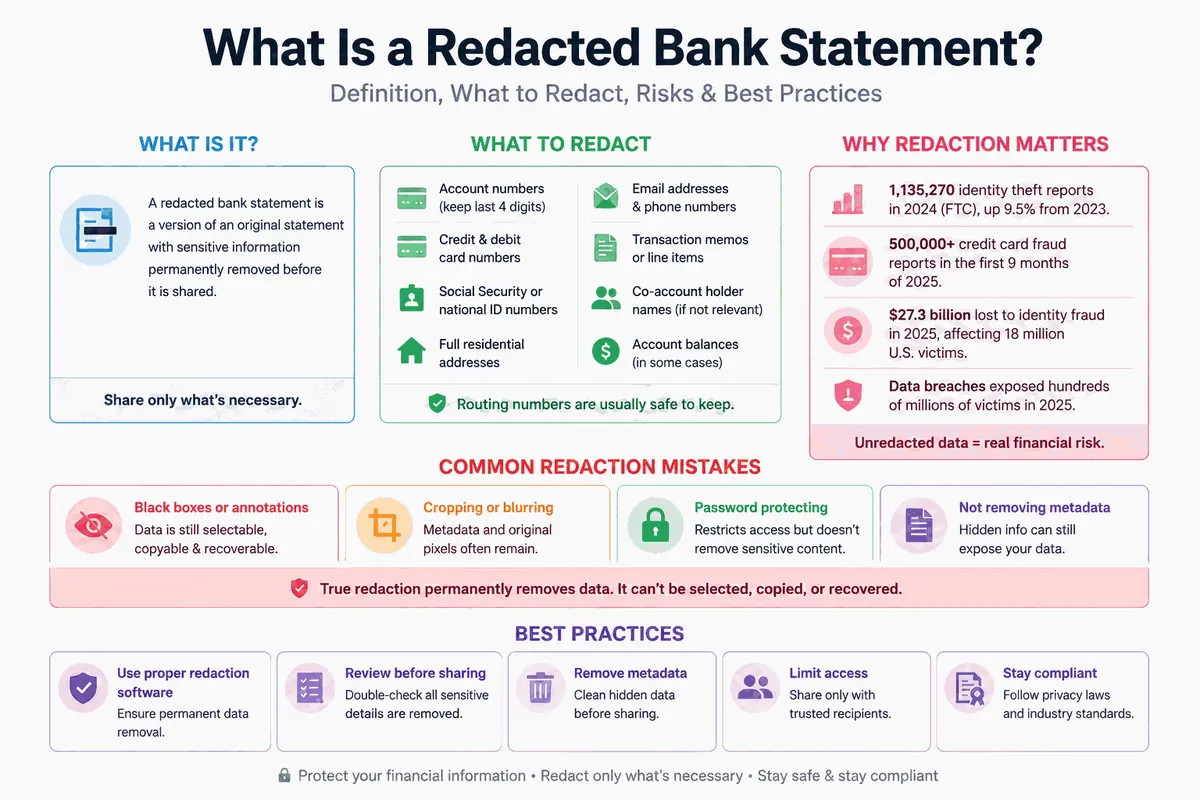
In both cases, you deal with the same idea. But the main difference is the document. In a bank statement, you can see many transactions and a balance. If you look at an invoice, you will see that the doc shows one bill. Our guide to redacted bank statements covers what to remove on a statement.