What Is a Redacted Bank Statement?
By PDFized TeamPublished on Updated on 8 min read
Bank statements are among the most requested (and most sensitive) documents in modern financial life. Landlords are sure to ask for them for tenant screening, lenders do the same for underwriting, employers want them for verification, and courts want them because, well, evidence matters. In almost none of these cases does the requesting party need to see everything on the page. That's where redaction comes in.
A redacted bank statement is a copy of the original in which fragments of sensitive information are permanently removed before the document is shared. It still functions as a valid, usable financial record; it simply no longer exposes data that a recipient has no legitimate need to see. (The general redacted meaning is covered in our plain-English guide.)
For anyone working in document security, compliance, or redaction software, understanding exactly what this process involves (and where people get it wrong) is foundational. Here's a full breakdown.
Defining Redaction vs. Simple Masking
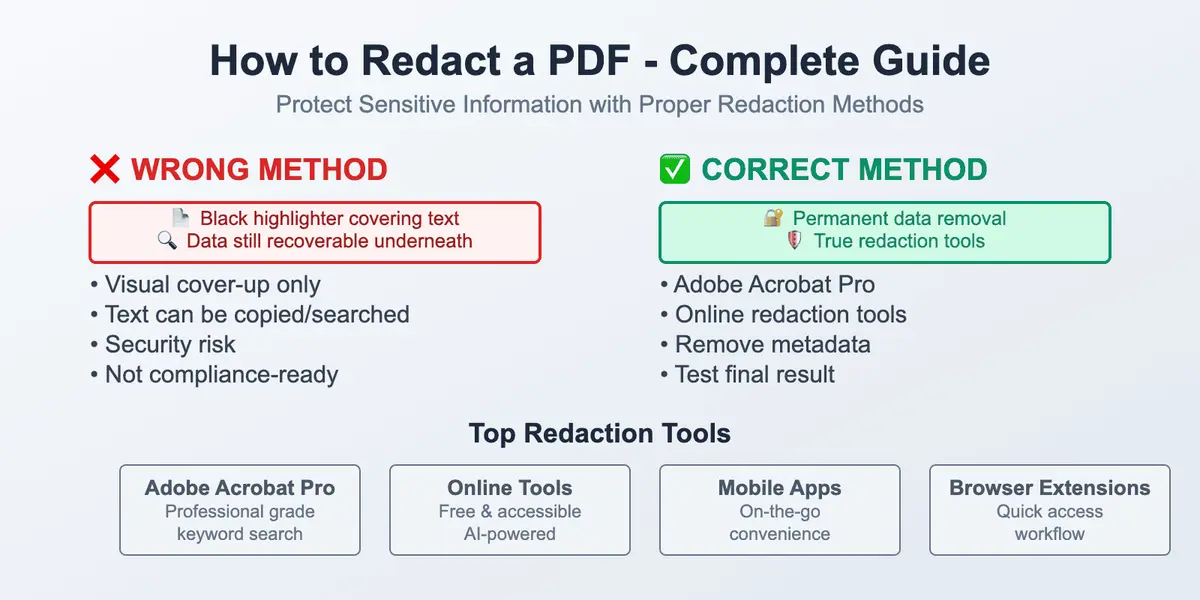
True redaction involves removing the underlying data from the file totally. If you're looking for step-by-step instructions, see our guide on how to redact a PDF. Do not confuse it with things like…
- Drawing a black box over text with a shape or annotation tool (the text remains selectable, copyable, and recoverable underneath)
- Cropping or blurring a screenshot (metadata and, often, the original pixels remain intact)
- Password-protecting a file (this restricts access but doesn't remove the sensitive content itself)
Proper redaction – whether performed manually or with dedicated software – makes the covered information permanently unrecoverable: it can't be selected, copied, extracted from the file's underlying text layer, or restored by converting the document back to its original format. This distinction matters enormously in practice, and it's the single most common point of failure when people redact documents themselves. Learn more about the differences between data redaction and data masking.
What Information Typically Gets Redacted
There's no universal answer – but as a rule, redact the following:
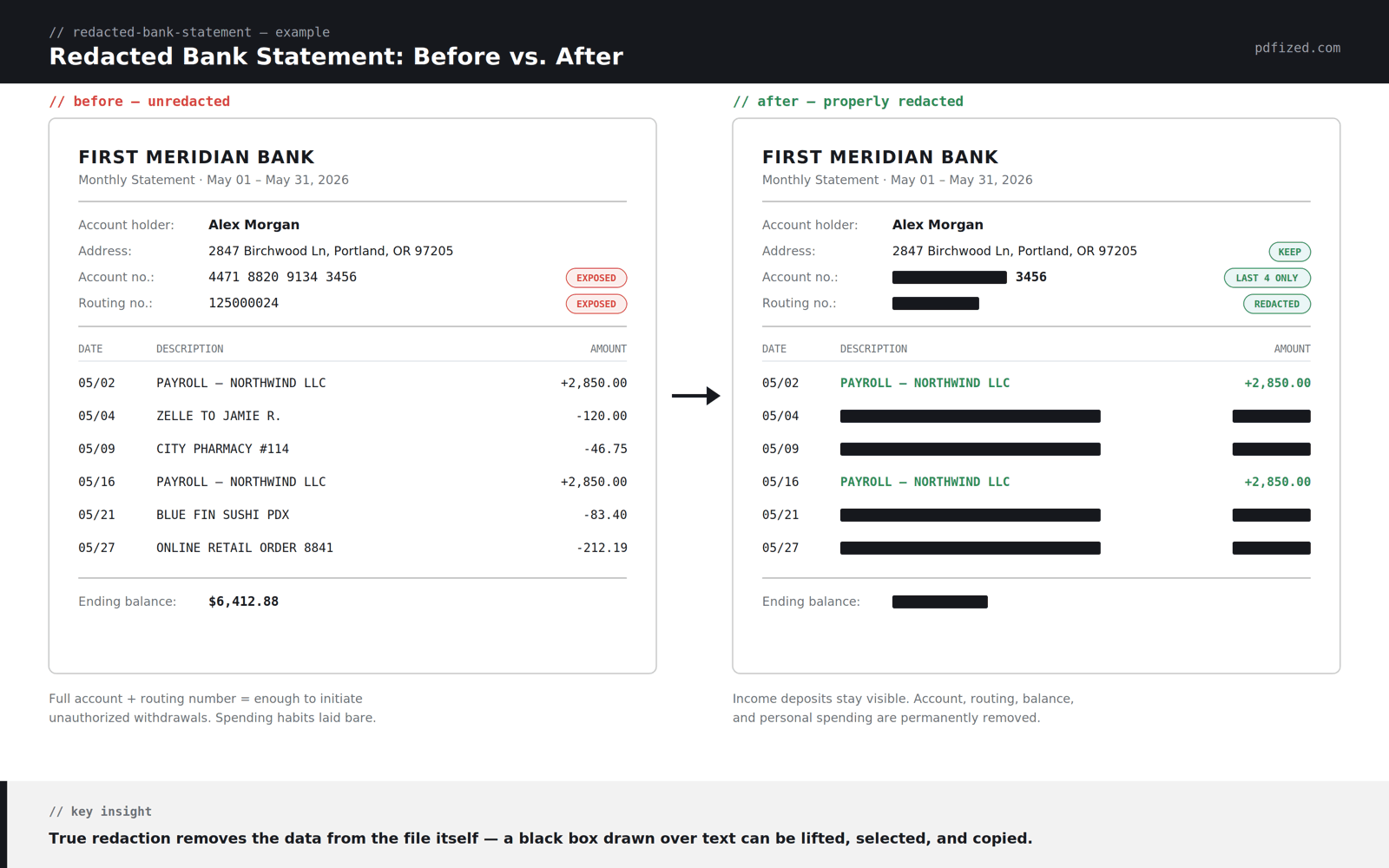
- Account numbers (typically reduced to just the last four digits, e.g. •••• •••• •••• 3456)
- Credit and debit card numbers
- Social Security numbers or national ID numbers
- Full residential addresses (unless the recipient needs yours to confirm identity)
- Email addresses and phone numbers
- Specific transaction memos or line items
- Co-account-holder names not relevant to the request
- In some cases, account balances
- Names in peer-to-peer transfers (Zelle, Venmo, etc.) – protects friends and family who appear in your history
- Handwritten or digital signatures, if the statement includes any
Routing numbers are a gray area. On their own they're low-risk – they identify the bank, not you, and are publicly listed. But paired with a visible account number, a routing number is enough to initiate unauthorized ACH withdrawals. The safe rule: if any part of your account number stays visible, redact the routing number. To redact an account number from a bank statement, leave only the last four digits visible (for example 3456) and remove the rest on every page – statements repeat it in the header or footer of each one.
What should stay visible
A statement that's all black boxes helps nobody. For the document to still do its job, keep these untouched: your full name and address (identity match), the bank's name and logo (authenticity), the statement period dates, the last four digits of the account number, and the specific transactions the recipient actually asked about – income deposits for a landlord, deposit history for a lender. Everything else is fair game for the black box.
Redacted Bank Statement Example: Before and After
Here’s how all of this looks in practice – the same statement before and after proper redaction:
Redacting a bank statement?
PDFized removes account numbers and personal details while keeping it a valid record – free.
Why Redaction Matters: The Risk Picture
The case for redaction isn't theoretical – it's backed by a large and growing body of fraud data.
- The FTC's Consumer Sentinel Network logged 1,135,270 identity theft reports in 2024, up 9.5% from 2023, and reports for the first three quarters of 2025 alone had already exceeded the total for all of 2024 – putting 2025 on pace to be a record year.
- Credit card fraud is consistently the single most-reported form of identity theft, with 449,076 FTC reports in 2024 and over 500,000 in the first nine months of 2025.
- Javelin Strategy & Research estimated identity fraud losses of $27.3 billion in 2025, affecting roughly 18 million victims in the U.S. alone. Its 2026 Identity Fraud Study confirmed losses held at that level – and found that new-account fraud, the type most directly enabled by leaked account details, surged 31% in victim count. Account takeover remained the costliest category at over $15 billion, hitting 6 million consumers, an 18% jump year over year.
- Data breaches remain a primary feeder for this fraud: the Identity Theft Resource Center recorded a record number of U.S. data compromises in 2025, with hundreds of millions of victim notices issued, and most breaches exposing full Social Security numbers alongside names.
An unredacted bank statement handed to the wrong party – or leaked from an improperly secured shared drive – enables a fraudster to open credit lines, file fraudulent loan applications, or pursue account takeover. This is the practical, quantifiable reason redaction has moved from "nice to have" to standard operating procedure across lending, HR, legal, and real estate workflows.
The Regulatory Backdrop
Redaction isn't just a privacy courtesy – it intersects directly with financial data protection law.
- In the United States, the Gramm-Leach-Bliley Act (GLBA) requires financial institutions to safeguard “non-public personal information” (NPI) of every client. Plus, it imposes privacy notices and data-sharing limitations on that info. While GLBA governs institutions rather than individuals directly, it establishes the regulatory logic that redaction practices mirror: share only what's necessary, protect the rest.
- In the EU/UK, data minimization principles under GDPR-aligned frameworks similarly encourage limiting the personal data disclosed to only what a given purpose requires – a principle regularly cited when businesses redact employee or client bank statements before onward disclosure.
- Court and FOIA-style disclosures operate under their own, often stricter, redaction rules – for example, financial account numbers and SSNs in U.S. court filings are typically limited to the last four digits, and dates of birth to the year only.
None of this makes redaction optional theater. It's the mechanism by which “share only what's needed” becomes an actual, auditable practice rather than a policy statement.
Common Real-World Scenarios
Redaction requirements vary significantly by who's asking and why:
- Mortgage and loan underwriting. Lenders generally need deposit history, balance trends, and evidence of large or irregular deposits – regulatory guidelines (e.g., for FHA-backed loans) often require large deposits exceeding a set share of qualifying income to be explained and documented. This means underwriters frequently push back on over-redaction; account numbers can usually be trimmed to the last four digits, but transaction-level detail is often non-negotiable.
- Rental applications. A redacted bank statement for a landlord should still show your name, the statement period, and the income deposits – landlords typically only need proof of consistent income, not a full transaction history. Overdraft fees, negative balances that have since been resolved, or unrelated purchases are commonly acceptable to redact, provided income deposits remain visible.
- Legal and court proceedings. Divorce discovery, litigation, and audits routinely require financial disclosure, but courts have established conventions (last-four-digits only for account and SSN fields, year-only for dates of birth) and may allow redaction of details (like transaction locations) that are irrelevant to the matter at hand but could otherwise be misused.
- Employment and immigration/visa verification. These use cases tend to need the least detail: name, address, and proof of consistent account activity, with account numbers, card numbers, and full transaction descriptions redacted. If all the recipient needs is proof of address, a redacted billing statement – a credit card or utility bill with the account number and charges blacked out – often does the job without exposing your banking history at all.
- Tax filing. Statements submitted directly to a tax authority generally should not be redacted, since the authority needs the unaltered record to verify income and deductions. Redaction becomes relevant only when statements are shared with a third-party platform in connection with a tax-related application. The same logic applies when you share a redacted tax return alongside your statements.
The through-line across every scenario: redact what others shouldn’t see, keep what's OK to be shared with third parties, and don't let the redaction itself raise doubts about the document's authenticity. Over-redaction is a documented cause of application delays and, in some underwriting cases, outright rejection.
How to Get a Redacted Bank Statement
Three broad approaches exist:
- Manual/physical redaction – marking over printed statements with a permanent marker. Cheap, but notoriously unreliable; held up to light, marker ink frequently fails to fully obscure text underneath, and there's no audit trail.
- General-purpose editors (Adobe Acrobat, Microsoft Word's "Restrict Editing," Google Docs' Find & Replace, Preview on Mac). These work for occasional, low-volume use but require the operator to correctly use an actual redaction function (not just a black box annotation) and to manually check every page, header, footer, and transaction memo for missed exposures.
- Dedicated redaction software. Purpose-built platforms add automated PII detection (often AI/ML-based), OCR for scanned statements, consistent redaction-symbol formatting, metadata scrubbing, audit logs, and batch processing across large document volumes – capabilities that materially reduce the error rate. For any organization processing bank statements at scale (lenders, property managers, HR teams, legal departments) – the operational case for automated tooling over manual methods comes down to two things: consistency (nothing gets missed across dozens or hundreds of pages) and verifiability (proof the redaction is permanent, not just visually applied). This is precisely the gap that dedicated financial document redaction software is built to close, replacing manual, page-by-page guesswork with a repeatable, auditable process.
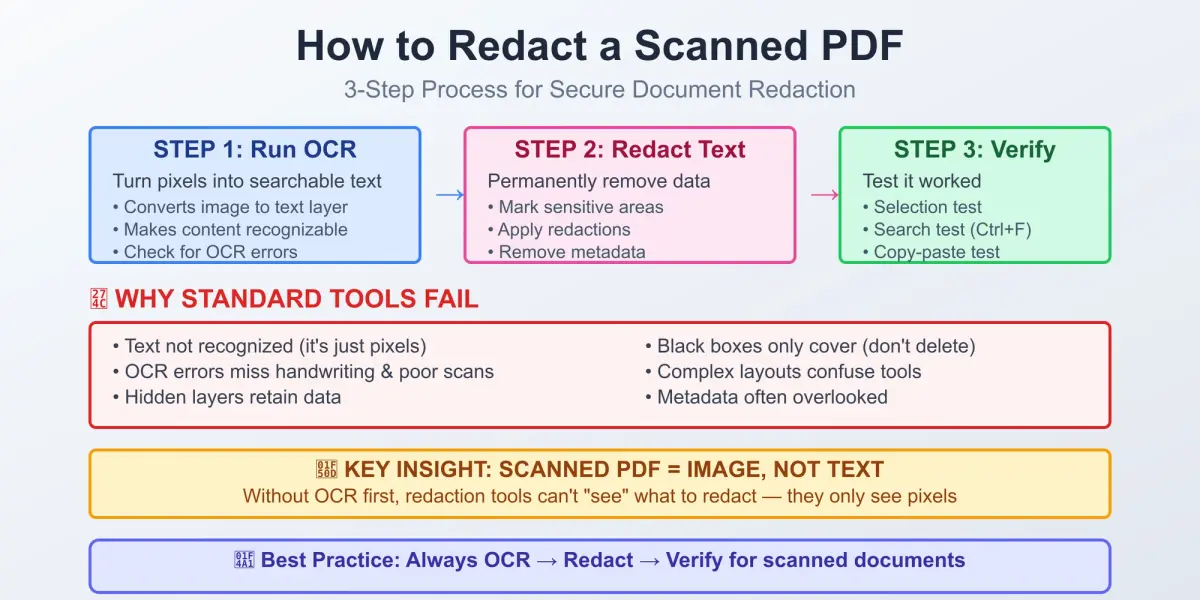
One special case worth flagging: scanned or photographed statements. Here the sensitive data lives inside an image, not a text layer, so standard PDF redaction tools can't even find it – the file needs OCR first, then permanent redaction applied to the recognized text. We cover the full process in our guide to redacting a scanned PDF.
Top Errors That Undermine Redaction
One can notice the same errors in all manual and semi-automated workflows:
- Incomplete redaction – a black box or highlight simply put over the text, but the underlying text layer is untouched and remains selectable/copyable.
- Screenshotting instead of redacting – this leaves image or file metadata behind and isn't true redaction.
- Missing secondary locations – page footers, running headers, and recurring transaction memos are the most commonly overlooked fields.
- Failing to scrub metadata – even after visible content is removed, embedded document metadata can retain author names, prior edit history, or other identifying details. After redacting sensitive information, it's also important to remove metadata from your PDF to prevent hidden information from being exposed.
- Over-redaction – removing so much that the recipient can no longer verify income, balance trends, or authenticity, triggering follow-up requests or rejection.
- Inconsistent redaction – masking a checking account number but leaving a savings or credit account number exposed on the same page.
- Skipping verification – the final test takes ten seconds: open the redacted file in a different viewer and try to select, copy, or search the blacked-out areas. If anything comes back, the redaction failed. More on what's at stake in what happens if redaction fails.
Is It Legal to Redact a Bank Statement?
Yes. If you do it for a legitimate purpose, it is standard, lawful practice. It is all about the intent: redaction to protect privacy is acceptable. What is not is altering, falsifying, or selectively hiding information specifically to mislead a lender, court, or counterparty. For court submissions in particular, redaction scope should follow the presiding jurisdiction's specific rules, and legal counsel should be consulted where requirements are unclear.
The Bottom Line
A redacted bank statement lets someone prove what they need to prove (income, account activity, identity, address) without exposing the full financial picture behind it. Given that identity theft reports climbed to record levels in the U.S. in 2025 while fraud losses held at $27 billion, and that a large share of that fraud traces back to exposed account numbers and identifying details, treating redaction as a formality rather than a control is a mistake organizations increasingly can't afford. The technical distinction between genuine redaction and simple visual masking isn't pedantic – it's the entire point.
// faq
FAQ
It's a copy of an original bank statement where sensitive details like account numbers, Social Security numbers, full addresses, and transaction memos have been permanently removed before sharing.
No. Whether you draw a black box or blur anything, the underlying text or pixels do not go anywhere. Plus, it can be easily recovered. True redaction removes the data from the file itself. No restoring is possible.
Full account and card numbers, Social Security or national ID numbers, full addresses, emails and phone numbers, specific transaction memos, co-account-holder names, and sometimes balances.
Yes, as long as you're redacting your own statement (or one you're authorized to redact) for a legitimate purpose, like protecting privacy while still providing needed verification.
Trusted redaction software is the top dependable option since it uses automated detection to catch sensitive fields consistently. It is not just a visual cover-up.
Applying a black box or highlight over text without removing the underlying text layer, so the “redacted” info is still selectable, copyable, or recoverable.
Almost always, yes. Just keep the basics visible: your name, the bank's logo, the statement dates, and the deposits they asked to see. A short note saying you've hidden the rest for security usually lands well.
Yes, if your account number (or part of it) is still visible. On its own, a routing number is public info. Together with an account number, it's enough to pull money from your account.