What Is Data Anonymization? All You Have to Know
By PDFized Team·Published on ·8 min read
Data anonymization means that all personal details get removed from some dataset/doc. Thus, you can't identify anyone in it anymore. When everything is anonymized, it's not personal data anymore in the legal sense. That's why regulators, researchers and companies do their best to get it right.
That last part is the catch. You may see how they call many datasets “anonymous.” But the problem is that most are only lightly disguised. And the worst thing here is that a skilled analyst can easily bring everything back. This guide will help you in the process.
Data Anonymization Definition
Check out GDPR to get the best possible definition. Based on what we see in Recital 26, the regulation does not apply to anonymous info. It means information that isn't linked to an identified or identifiable person, or to personal data rendered anonymous in such a way that the individual is not or no longer identifiable. The same recital adds the test that matters in practice: you have to account for all the means reasonably likely to be used to identify someone, including by a third party, taking into account cost, time and available technology.
In other words, data anonymization is a standard, not a checkbox. If you delete a field with a person's name but the rest of the text still shows who s/he is, you hide nothing.
A working definition for everyday use: data is anonymized when nobody, inside or outside your organization, can tie a record back to a real person using reasonable effort, and there is no key anywhere that would let them.
Anonymization vs. Pseudonymization
Yes, that's something people confuse here and there nonstop. The truth is that the difference has legal consequences.
All identifiers get replaced by pseudonymization with artificial identifiers. The latter includes something like a customer ID or a token. But pseudonymization keeps a way to link them back. GDPR Article 4(5) defines it as processing where the data can no longer be attributed to a person without additional information that is kept separately. The key still exists, so the data is still personal data and GDPR still applies in full. Pseudonymization is a security measure, not an exit from regulation.
Anonymization removes the possibility of linking back altogether. No key, no reverse mapping, no reasonable route to a name. Only then does the data leave the scope of the law.
Take a look at a quick test: if a court order could make you re-identify the people in a dataset, you can state that it was pseudonymized. If you could not do it even if ordered, anonymization is in the game.
Anonymization vs. Redaction and Masking
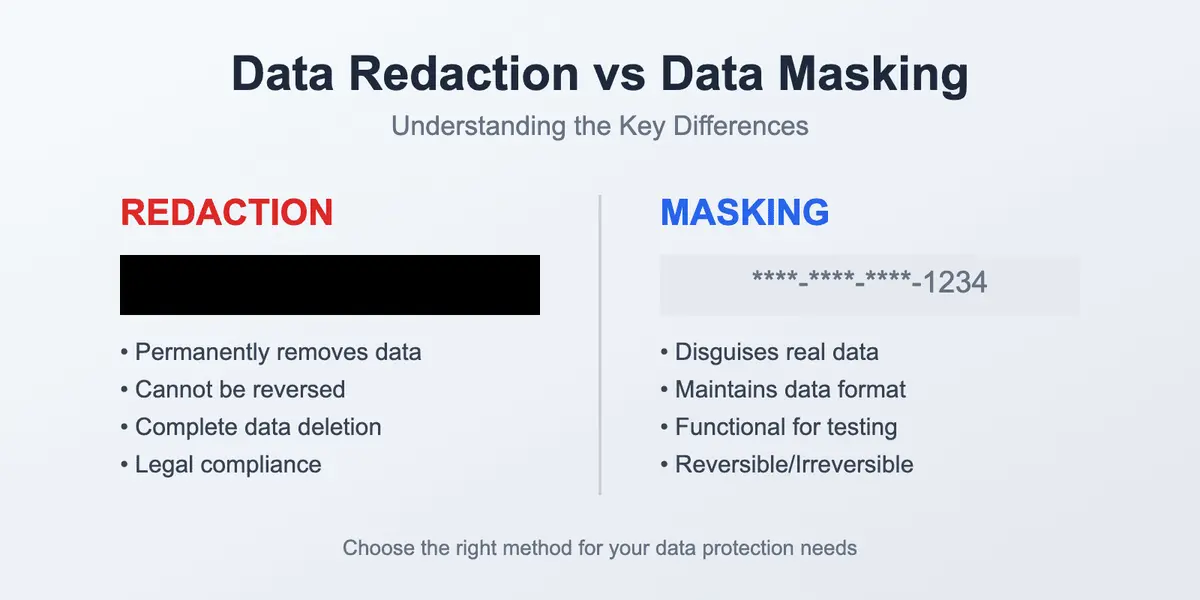
If some data is anonymized at the doc-level, it's called redaction. The user doesn't transform a column in a database, but simply removes specific words, numbers or regions from a file permanently. The files are usually PDF, scans, or pics. When you redact a PDF properly, it has no more info. It's not like you hide it. It's gone for good.
Masking is broader and usually reversible or partial. Showing a card number as 4417 is masking. The full guide to data redaction vs data masking covers when each one is the right call.
Why Anonymize Data at All?
Three reasons come up in almost every project.
- Compliance => anonymized data is outside GDPR and, under HIPAA, properly de-identified health data is no longer protected health information. That changes everything, from stuff you store to what you share and analyze without consent, retention limits or breach notification duties.
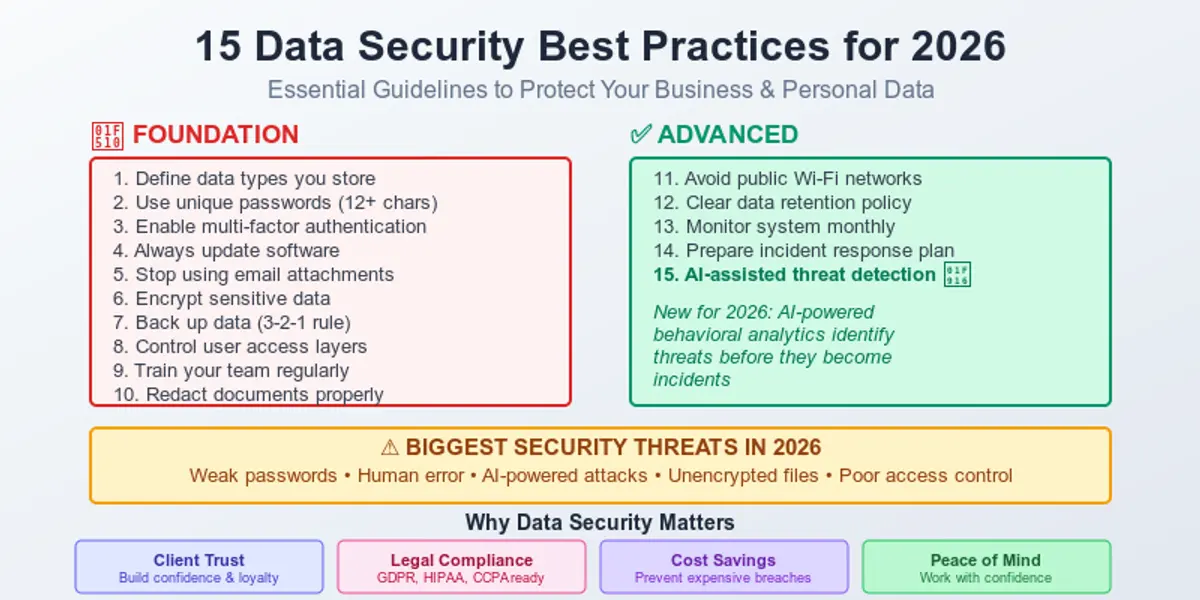
- Risk reduction => data you do not hold cannot leak. If there are names, addresses or account numbers in some dataset, it's a liability waiting for the next breach. Anonymization helps a lot. It's one of the most effective data security best practices. And it's effective because it shrinks the target rather than defending it.
- Sharing and reuse => research partners, vendors, auditors and public records requests all need data without needing the people behind it. Anonymization lets you hand over the useful part and keep the sensitive part.
Techniques to Anonymize Info
One technique that would do all the job doesn't exist. For you, we have the top popular:
1. Suppression (Removal)
Just get rid of stuff like names, email addresses, Social Security numbers, phone numbers totally. It's very simple and, as you can see, 100% effective. The cost is that you lose whatever analytical value the field had. Suppression is the right default for direct identifiers, the fields that name a person on their own. Knowing what counts as PII (personally identifiable information) is the starting point, because the list is longer than most people expect.
2. Generalization
Replace precise values with broader ones:
- a birth date becomes a birth year or an age band
- a full ZIP code becomes the first three digits
- an exact salary becomes a range
The record stays useful for statistics but stops pointing at one person. The risk is in the outliers: a 90-year-old in a small town is identifiable even with an age band, which is why HIPAA’s Safe Harbor method groups everyone over 89 into a single “90 or older” category.
3. Masking
Overwrite part of a value with a fixed character while keeping its format. Masking helps a lot if you're dealing with interfaces, test environments and documents. In each, the data shape matters but the content does not. On its own, masking is often partial. Sometimes it can even be reversible. So it is usually paired with suppression for anything high-risk.
4. Pseudonymization
Swap identifiers for consistent tokens. That's why records can still be linked across tables or over time. Based on the info above, this does not produce anonymous data. But the fact is that it is a must inside most anonymization pipelines. Here's why: it's because it lets you analyze longitudinal data before the final de-identification pass.
5. Noise Addition and Differential Privacy
Add small random changes to numeric values so that any individual record is slightly wrong, while aggregate results stay accurate. Differential privacy formalizes this with a mathematical guarantee of how much any one person’s data can influence the output. The US Census Bureau used it for the 2020 census. It is powerful for statistical releases, and mostly irrelevant for documents.
6. Synthetic Data
Generate an artificial dataset with the same statistical properties as the real one. Zero people appear in it, so the privacy question goes away. The downside is fidelity: usually stuff like rare patterns and edge cases simply disappear. Plus, generating good synthetic data really needs a bag of expertise.
Data Anonymization Examples
Example 1: A Redacted Medical Record
A hospital releases records for a research study. Under HIPAA’s Safe Harbor method, it removes all 18 identifier types listed in the HHS de-identification guidance, including names, dates more specific than the year, and any geographic unit smaller than a state. What remains, such as diagnosis, treatment and outcome, is useful to researchers and no longer protected health information. Our guide to redacted medical records walks through all 18 identifiers with examples.
Example 2: A Court Filing
Federal courts require filers to reduce identifying details to the minimum the case needs:
- Social Security numbers => last four digits only
- birth dates => year only
- minors’ names => initials
The document stays readable and legally complete, but it no longer exposes the people in it.
Example 3: When Anonymization Fails
In 2006, Netflix published 100 million movie ratings from about 480,000 subscribers with names replaced by random numbers. Two researchers at the University of Texas showed that by matching rating dates against public IMDb reviews, they could identify individual subscribers from just a handful of ratings. The dataset was pseudonymized, not anonymized, and the “harmless” ratings turned out to be a fingerprint.
The lesson repeats across every famous failure: it is the combination of ordinary fields, not any single sensitive one, that identifies people. Latanya Sweeney’s well-known finding that ZIP code, birth date and sex together uniquely identify the large majority of Americans is the same point. Any serious anonymization process has to consider the quasi-identifiers, not just the obvious ones.
How to Anonymize Data: A Short Process
- Inventory the identifiers => list direct identifiers (name, SSN, email) and quasi-identifiers (dates, locations, job titles, rare attributes).
- Decide what the data is for => the purpose determines how much precision you can afford to lose.
- Suppress direct identifiers => no exceptions.
- Generalize or perturb quasi-identifiers => until no combination points to a small group of people.
- Check for leaks outside the main fields => document metadata, hidden layers and file history routinely carry names after the visible text is clean, so remove metadata from the PDF before sharing.
- Test re-identification => the user can put the names back using data they could plausibly obtain. If that's something possible, it's crucial to go to step 4 again.
- Document the method => regulators and auditors ask how, not just whether.
For documents rather than databases, steps 3 to 5 are what an automated PDF anonymizer does: detect the identifier types, remove them from the file itself, and strip the metadata so the result can be shared.
// faq
FAQ
No. Genuine and irreversible data anonymization means that GDPR does not apply. If any key or reasonable method exists to reverse it, the data is pseudonymized and remains fully in scope.
No. Reversible techniques (stuff like tokenization/encryption) are pseudonymization or security controls. That has nothing to do with anonymization.
Simply put, redaction is anonymization that is applied to various docs. It cuts all kinds of identifying content from a file for good. If you simply black out fragments of text visually, the info doesn't go anywhere. And no anonymization happens.
Suppression, because removed data cannot be recovered. It is usually combined with generalization so the remaining data stays useful.