FOIA Request Redaction: How to Apply the 9 FOIA Exemptions
By PDFized TeamPublished on 8 min read
If you are asked to do a FOIA request redaction, here's what it is about: you have to remove only the info that one of the nine FOIA exemptions cover in 5 U.S.C. § 552(b), marking each deletion with its exemption code, like (b)(6), and releasing the rest of the record. An agency can’t hold back a whole document just because one line in it is sensitive. Plus, withholding information is possible only when releasing it would actually harm something the exemption protects.
In practice it goes like this. A FOIA request lands in your inbox and the clock starts ticking. Somewhere in a few hundred pages of emails, memos and case files sit names, phone numbers and internal discussions that can't go out the door. Your job is to find every one of them.
But users have to be careful because when they redact too little, they'll inevitably release protected data. But if you redact too much stuff, the requester will appeal, and sometimes sue. If you've ever looked at redacted government documents and wondered why some lines are blacked out and others aren’t, the nine exemptions are the answer. Check out this guide we made for you exclusively to walk you through each one. You'll see what FOIA redaction covers under it. Enjoy our step-by-step process for the best release possible.
What Happens When an Agency Receives a FOIA Request
A federal agency has 20 working days to respond to a FOIA request. In unusual circumstances, it can add up to 10 more. Most of that time goes into finding the records and reading them line by line. States have their own public records laws and deadlines, but the review itself works much the same way.
Whatever redaction decision you make, you stick to the main rules in the Freedom of Information Act, 5 U.S.C. § 552:
- Segregability. If part of a record is releasable, release it because it's crucial. Never redact the whole memo. Do that with the name only.
- Marking. In the released record, you have to demonstrate how much was deleted and which exemption applies. The exemption code must go right at the spot of the deletion wherever it's possible.
- Foreseeable harm. Since the FOIA Improvement Act of 2016, it's not enough if you simply fit an exemption. The agency's task is to foresee that releasing the info would harm an interest the exemption protects, or point to another law that blocks disclosure.
What we mean is that you can’t just match information to an exemption anymore. There must be some solid reason the release would actually cause harm.
Working on a FOIA request?
PDFized finds personal data in your records and removes it permanently – free to start.
The 9 FOIA Exemptions and What to Redact Under Each
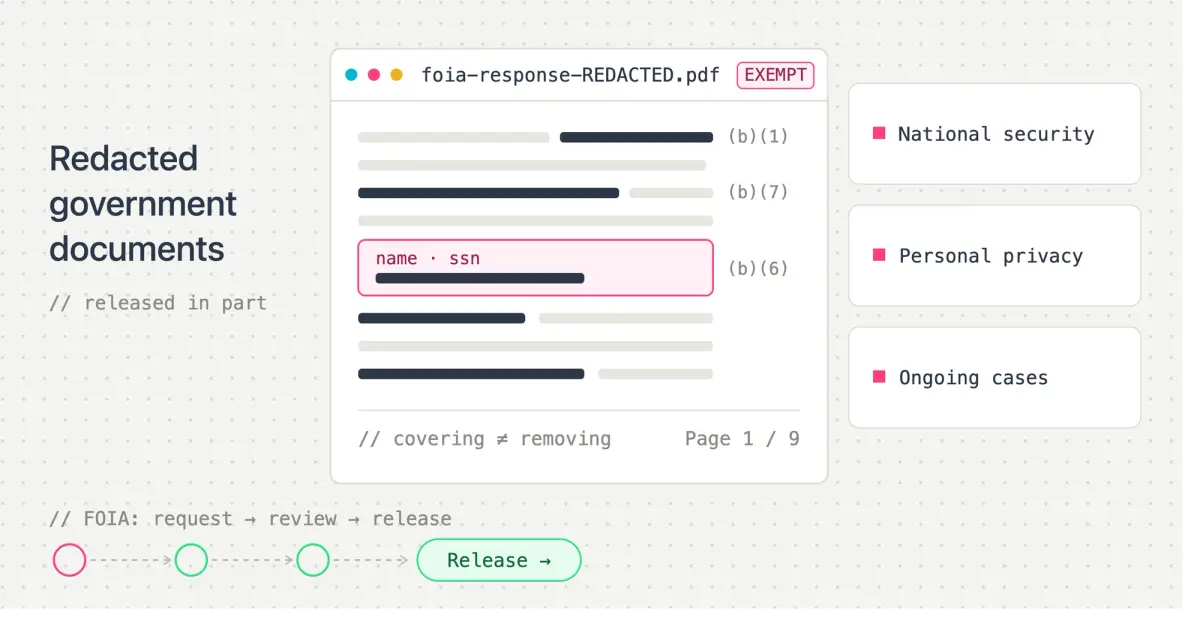
There's a code for all the 9 FOIA exemptions. The stamps there appear on each of the released pages. Here's what every single thing covers:
- (b)(1) Classified information. Material classified under an executive order to protect national defense or foreign policy. Redact it only if it’s still classified when you review it.
- (b)(2) Internal personnel rules. Records about an agency’s internal personnel practices and nothing else. Since Milner v. Department of the Navy (2011), this one is narrow and rarely used.
- (b)(3) Information protected by another statute. Data some other federal law specifically shields, like tax returns or grand jury material. Cite that law next to the code: “(b)(3): 26 U.S.C. § 6103”.
- (b)(4) Trade secrets and confidential business information. Commercial or financial details a company shared in confidence – pricing, unit costs, proprietary processes. Contractor proposals are the classic case.
- (b)(5) Privileged agency communications. Drafts, recommendations and legal advice covered by the deliberative process, attorney-client or work-product privileges. This is FOIA Exemption 5, and it has limits: redact the opinions, release the facts you can separate out, and remember the deliberative process privilege dies once a record turns 25.
- (b)(6) Personal privacy. Personnel, medical and similar files where release would clearly invade someone’s privacy. FOIA Exemption 6 is the code you’ll see most: home addresses, personal phone numbers, dates of birth, Social Security numbers, medical details.
- (b)(7) Law enforcement records. Records compiled for law enforcement, but only where release would cause one of six harms:
- (A) interfere with enforcement proceedings
- (B) deprive someone of a fair trial
- (C) unreasonably invade personal privacy – usually names of witnesses, suspects and officers
- (D) reveal a confidential source
- (E) expose investigative techniques that would help someone evade the law
- (F) endanger someone’s life or safety
- (b)(8) Financial institution reports. This category includes docs that are prepared by or for agencies, regulating banks.
- (b)(9) Geological data on wells. Maps and geophysical data about wells – mostly oil, gas and water records.
In a typical response, (b)(6) and (b)(7)(C) do most of the work, because almost every record mentions somebody’s personal details. You’ll find both exemption codes all over a redacted police report. For the case law behind each code, the Department of Justice’s Guide to the Freedom of Information Act has a chapter per exemption.
FOIA redaction example
Here’s a short passage from an agency email, before and after review:
- Before: “Officer Dana Ruiz interviewed the witness, Mark Allen (555-0142), on March 3. Legal recommends we not pursue charges until the lab results are back.”
- After: “Officer [(b)(7)(C)] interviewed the witness, [(b)(6), (b)(7)(C)], on March 3. [(b)(5)]”
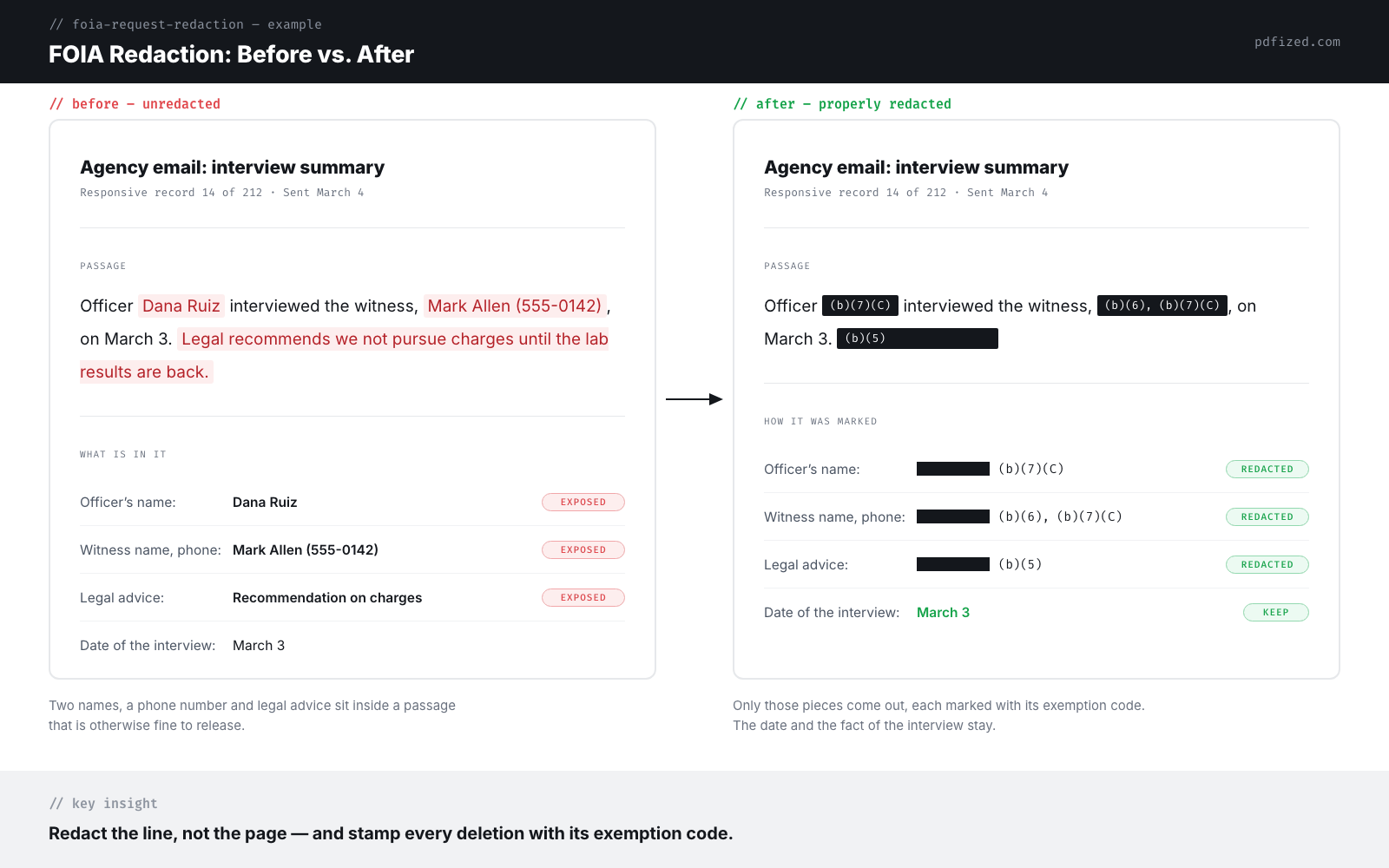
It is important that the date remains there and the fact that an interview happened. Nothing serious will happen if you release that. The names, the phone number and the legal recommendation come out. Each should be provided with a unique, separate FOIA redaction code.
How to Redact Documents for a FOIA Request: Step by Step
If the requester appeals, you'll have to keep your release defensible. You can take a couple of simple steps for that.
- Confirm the scope. Re-read the request. Everything that's covered should be pinned down. Here, we're talking about stuff like date ranges, custodians, record types. Skip everything else.
- Gather and convert the records. Pull the emails, attachments, scans and spreadsheets, then convert everything to PDF so each page gets reviewed and marked the same way.
- Remove duplicates. Email threads repeat the same text over and over. Deduplicate first, so you’re not redacting one line in ten places – or worse, redacting it in nine and missing the tenth.
- Flag exempt information. Go page by page and mark anything an exemption covers. Personal data under (b)(6) and (b)(7)(C) makes up the bulk of it, and it’s the easiest part to hand to automated FOIA redaction.
- Apply the foreseeable harm test. For every flagged item, ask what harm the release would cause. Discretionary exemptions, especially (b)(5), need a real answer, not just a fit.
- Redact and mark each deletion. Remove the text (don’t just cover it) and stamp the exemption code at the spot. For high-volume requests, FOIA redaction software can detect names, phone numbers and other (b)(6) data across a whole batch and apply the codes for you.
- Clean hidden data. Redaction boxes don’t touch metadata, comments, bookmarks or earlier file versions. Remove metadata from the PDF before release, because author names and file paths can reveal exactly what you redacted.
- Always do one more review. It's crucial to ask someone to check it to see if any missed data, over-redaction and consistent codes are there. Then search the final file for a few redacted terms and confirm they’re gone.
- Release with a cover letter. Say which FOIA exemptions you applied, how much was withheld, and how the requester can appeal.
Mistakes 100% Users Make
When users say they have problems in the process, usually they mean the few mistakes we list here:
- You just draw boxes (but you have to remove text!). A black rectangle in a PDF editor often leaves the text sitting underneath, one copy-paste away. Read more about rules for redacting documents.
- Withholding whole pages. If only a name and a phone number are exempt, the rest of the page goes out. Blanket withholding fails the segregability rule and tends to lose on appeal.
- Missing exemption codes. A redaction without a code leaves the requester guessing, and leaves you on weaker ground if the response gets challenged.
- Messy redactions. Redacting a name on page 3 but not in the same email on page 40 exposes the data and undermines the whole release.
- You forget about attachments and images. All items like scanned forms and embedded spreadsheets need the same review as the email body. You have to remember that the text inside an image won’t show up in a keyword search until the file has been through OCR.
- Leaning too hard on (b)(5). Treating every internal email as deliberative invites challenges. Facts, final decisions and records 25 or more years old don’t qualify.
// faq
FAQ
Federal agencies must decide within 20 working days. They can add up to 10 more days, if there are some unusual circumstances. Complex requests with lots of records often take months anyway, and redaction review is usually the slowest part.
It means the information was withheld under FOIA Exemption 6, which protects personal privacy. It usually covers names, contact details, dates of birth and medical information about private individuals.
Yes. If you are a requester, you can file an administrative appeal with the agency. Keep in mind that it must allow at least 90 days after the decision to do so. If the appeal fails, the requester can sue in federal court, where the agency has to justify every withholding.
No. FOIA covers federal agencies only. Each state runs its own public records law with its own exemptions, though most of them protect similar things: personal privacy, active investigations, that sort of category.