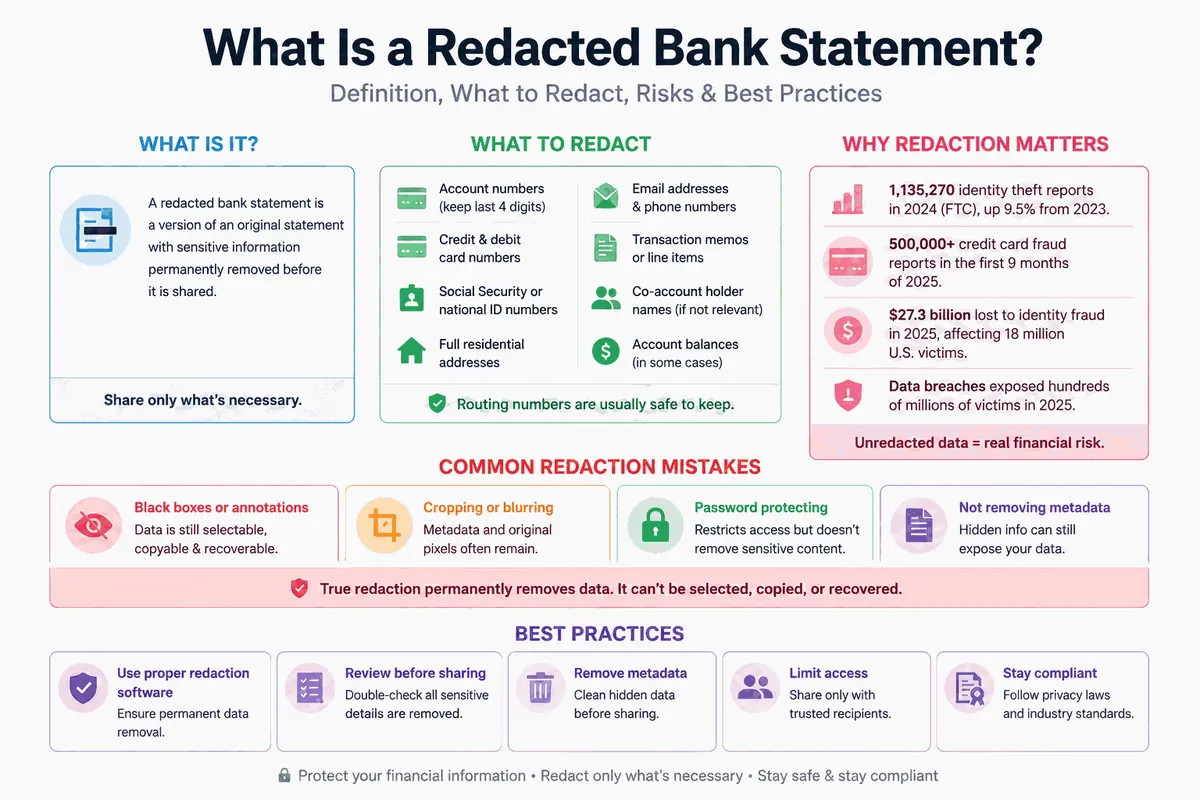
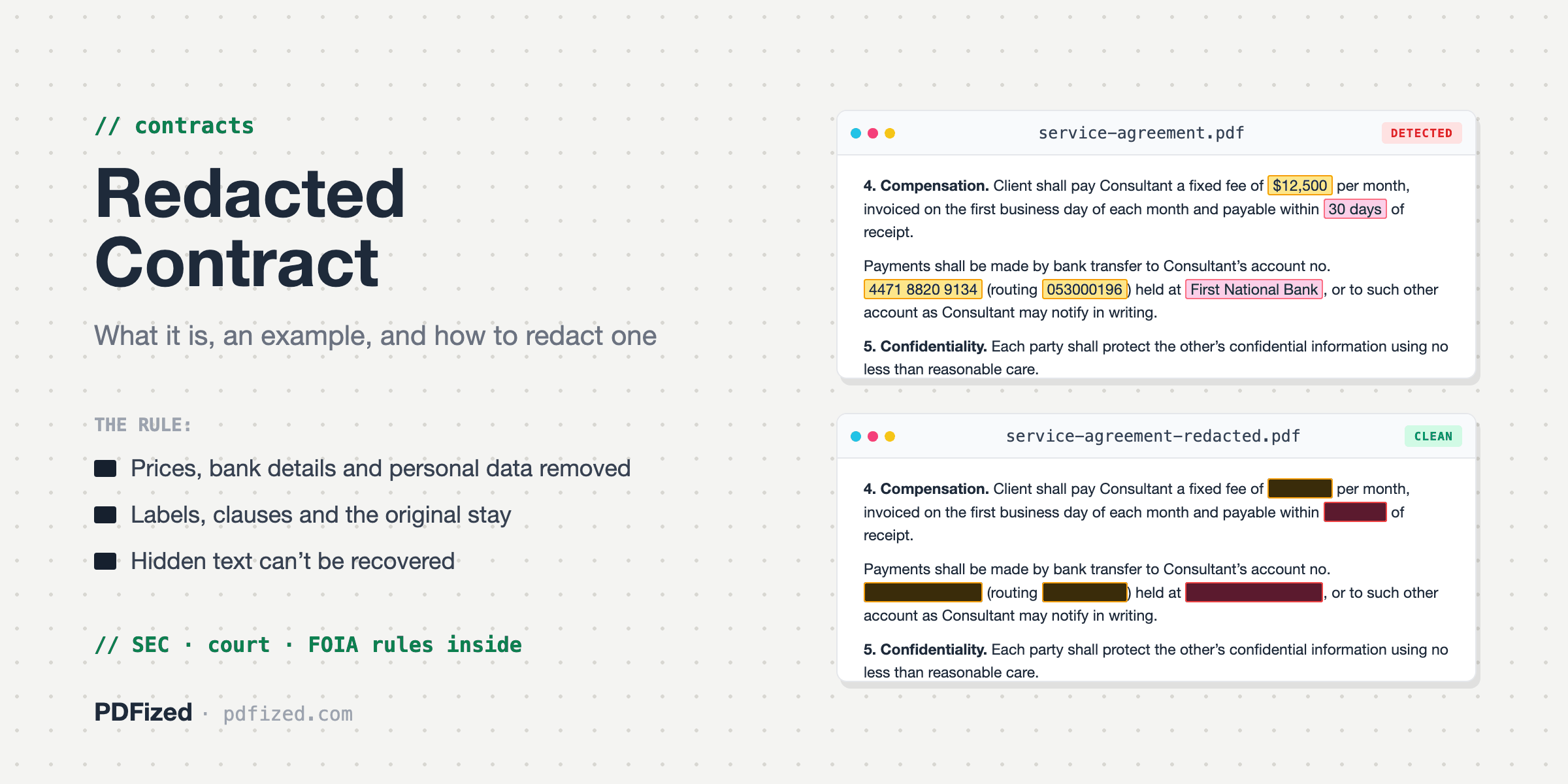
What Does Redacted Mean in Real Estate?
By PDFized TeamPublished on 8 min read
In real estate, “redacted” means some information in a document was hidden or removed before anyone else got a copy. You'll run into it most often on competing offers, contracts, bank statements and some public property records. Names, account numbers or addresses are blacked out, and everything else stays readable.
Redaction lets people share the part of a document the other side actually needs, like a price or a closing date, and keep private details that have nothing to do with the deal out of view.
What “Redacted” Means on a Real Estate Document
To redact is to edit a document so certain parts can’t be read (our guide to what redacted means covers the term in general). On paper, people used a thick marker. Today you’ll usually get a PDF in which selected words were removed and replaced with a black or white box, sometimes labeled “[REDACTED]”.
The document is still the real thing. Every word you can read matches the original exactly; only the hidden parts are missing.
So when you see a redaction, here is what you can and can't conclude:
- What it tells you: someone deliberately hid specific details, usually to protect a person’s privacy or financial security.
- What it doesn’t tell you: that the information was never there, is still being decided, or is wrong. A redacted price was a real price. You just can’t see it.
- What it doesn’t change: the document’s validity. A redacted copy is shared for information, while the unredacted original stays with the parties, their agents, the lender or the title company.
Two related terms come up as well. “Masked” usually means part of a number is shown, such as the last four digits of an account. “Shielded” is the word some states use for public property records that are hidden from general view.
Real Estate Documents that Are Often Redacted
Redaction can appear anywhere between the first offer and the public record. These are the documents where you're most likely to see it:
| Document | What is usually hidden | Why |
|---|---|---|
| Competing offer (escalation clause) | Buyer names, contact details, agent details | The buyer with the escalation clause needs the price and terms, not the rival buyer's identity |
| Purchase agreement shared with a third party | Signatures, personal addresses, sometimes price | Privacy when the contract is used as a reference or example |
| Bank statements and proof of funds | Account numbers, unrelated transactions | Shows the money exists without exposing the full account |
| Pay stubs and tax returns | Social Security numbers, employer IDs | Lowers identity theft risk when documents pass through many hands |
| Public land records | Names or locations of protected people | Some states shield people with safety concerns |
Not every party will accept a redacted copy. Lenders and title companies generally need complete documents to do their work, so ask first before you black anything out on a mortgage or closing file.
Sharing a competing offer or proof of funds?
Upload a copy to PDFized: buyer names and account numbers come out for good, the price and terms stay – free to start.
Why Real Estate Documents Get Redacted
Most buyers who search for this term have just been handed a redacted competing offer, so that reason comes first.
- To prove a competing offer without revealing the competitor. An escalation clause raises a buyer's offer by a set amount above a competing bid, up to a cap. To trigger it, the seller usually has to show proof of that competing offer. The Pennsylvania Association of Realtors explains that sellers can redact identifying information on the competing offer but must include all of its financial terms. Florida Realtors’ escalation addendum works the same way: the seller provides a copy of the competing offer with the other buyer’s identification redacted.
- To protect personal and financial data. One transaction can pass through agents, lenders, appraisers, inspectors, attorneys and title staff. Each extra copy of a Social Security number or bank account number gives it one more chance to leak.
- To keep negotiation details private. A seller might share part of a contract, a counteroffer or an inspection report and keep terms that don't concern the other party out of view.
- To protect people at risk. Some states let people with recognized safety concerns shield their information in public land records. The American Land Title Association lists law enforcement officers, judges, and victims of domestic violence or abuse as examples. In Arizona, the shielding generally lasts four to six years, and real estate professionals keep access.
Shielding comes with a cost. ALTA warns that redacted land records can make it harder to prove ownership and to buy, sell or borrow against a property, which is why title professionals usually keep access to shielded records.
Redacted Real Estate Offer: Before and After
Say you offered $400,000 with an escalation clause: you’ll beat any competing offer by $2,000, up to $420,000. The seller gets another offer and has to show it to you. All names, numbers and addresses below are fictional.
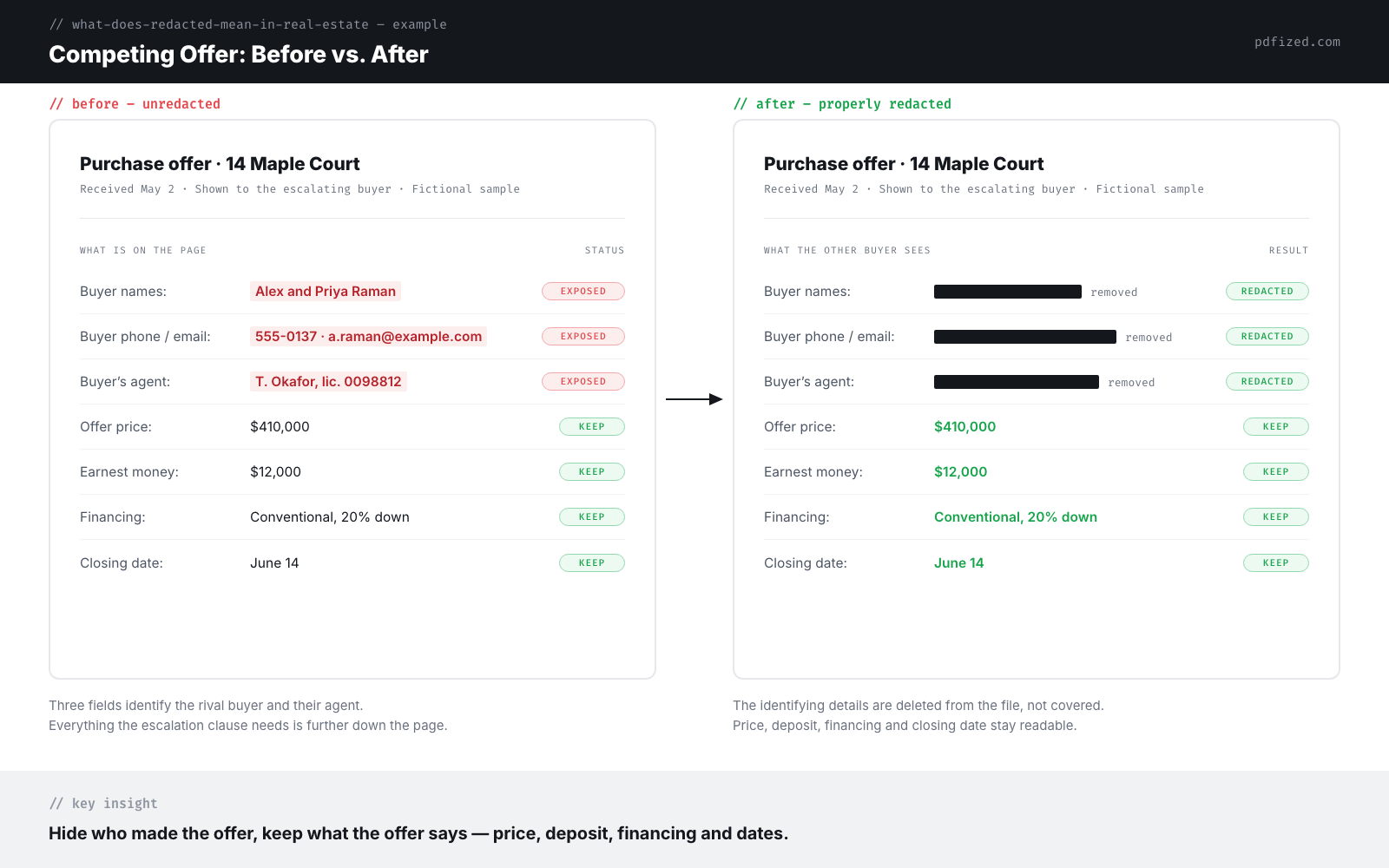
From the redacted copy, you can confirm two things:
- The competing price is $410,000, so your offer escalates to $412,000, still under your $420,000 cap.
- The two offers are comparable, with similar earnest money, financing and closing dates.
You won't learn who the other buyers are or how to reach them. You get enough to check the numbers, and they keep their privacy.
How to Redact a Real Estate Document Properly
An agent sharing a competing offer and a buyer sending proof of funds follow the same steps.
- Check what the other side needs. Read the escalation clause or the request. If it asks for the full financial terms, keep the price, deposit, financing and dates visible.
- List what to hide. The usual items are names, addresses, phone numbers, emails, signatures, license numbers, account numbers and Social Security numbers.
- Work on a copy. Leave the original unredacted file untouched and save it separately.
- Use a real redaction tool. It should delete the selected text from the file instead of covering it. Black rectangles drawn in a PDF editor, or a black highlight in a word processor, leave the text underneath.
- Remove hidden data too. PDFs can carry metadata, comments and earlier versions that still contain the names you hid on the page. Here’s how to remove metadata from a PDF.
- Check the result. Open the redacted copy, try to select and copy the hidden areas, and search for a name you removed. If anything turns up, the redaction failed.
- Share only the redacted copy. Send it as a new file, and note what you removed and when.
Browser-based real estate redaction software such as PDFized covers steps 4 to 6 in one pass. It deletes the selected text and image data from the file, strips the metadata, and saves the redacted version next to your untouched original.
Common Redaction Mistakes in Real Estate
- Covering text instead of removing it. It is also the easiest mistake to make. A recipient selects the black box, copies it, and pastes the name into an email. We explain why blacking out text in a PDF isn’t redaction in a separate guide.
- Redacting the numbers that matter. If an escalation clause calls for the competing price and you hide it, the buyer can’t verify the offer and may dispute the escalation.
- Missing repeated details. A name you hid on page one often shows up again in the signature block, the agent section or a page footer.
- Forgetting attachments. Proof of funds, pre-approval letters and addenda attached to an offer carry personal details of their own.
- Sending a redacted file where a full one is required. A lender, title company or closing attorney may reject it, and that can delay closing.
- Losing the original. If you overwrite the only copy, the hidden information is gone for you as well.
// faq
FAQ
It's a copy of another buyer’s offer with their personal details hidden. The financial terms stay visible, including the price, deposit, financing and closing date, so you can check whether your escalation clause applies.
Not if the offer was redacted properly, because the names were deleted from the file. If the agent only drew black boxes over the text in a PDF editor, the names are often still there and can be copied. That would expose the other buyer's details, so agents should use a tool that actually removes the text.
Only if your escalation clause says so, so put that requirement in writing before you submit the offer. Chase notes that escalation clauses typically require the seller to provide proof of a competing offer before your price goes up. Under Pennsylvania’s standard addendum, the listing agent must provide a copy of the competing offer, with identifying details redacted and all financial terms included.
Some states let people with recognized safety concerns, including law enforcement officers, judges and victims of domestic violence, shield their details in public land records. According to the American Land Title Association, title professionals usually keep access, so these properties can still be bought, sold and financed.