
What Does "Redacted" Mean in Court Documents?
By PDFized TeamPublished on 8 min read
What Does Redacted Mean in Court? The Short Definition
Redacted means that specific information in a document has been permanently hidden or removed before the document is shared with others. In court documents, redaction usually protects private details, privileged communications, or information a judge has ruled should not be public.
Redacted court documents still exist in full somewhere, such as in the court's sealed records or the filer's files. The version made available to the public or the opposing party simply has certain parts blacked out, whited out, or deleted.
Why Courts Redact Information
Court records are generally public, and most are now searchable online. That openness supports accountability, but it also puts personal details within reach of anyone, including identity thieves. Redaction is how courts balance the two. The main reasons are:
- Privacy protection. Preventing identity theft, harassment, and unnecessary exposure of personal details.
- Protecting minors. Shielding children involved in custody, abuse, or criminal cases.
- Attorney-client privilege and work product. Withholding legally protected communications during discovery.
- Trade secrets and confidential business data. Keeping proprietary information from competitors.
- Safety and national security. Concealing witness identities, informants, or sensitive government information.
- Court orders. A judge may direct that certain material be hidden for case-specific reasons.
Filing court documents?
PDFized permanently removes SSNs, minors' names, and account numbers from your filings – metadata included. Free.
What Gets Redacted in Federal Court
In U.S. federal civil cases, the rule is Federal Rule of Civil Procedure 5.2. Unless the court orders otherwise, a filing containing an individual's Social Security or taxpayer ID number, birth date, the name of a known minor, or a financial account number may include only limited portions of that data. In practice that means:
| Information | What may appear in the public filing |
|---|---|
| Social Security / taxpayer ID number | Last four digits only |
| Date of birth | Year only |
| Name of a minor | Initials only |
| Financial account number | Last four digits only |
Federal criminal cases follow a parallel rule, Criminal Rule 49.1. It adds home addresses, where only the city and state may be shown. Many state courts have their own versions, and details vary by jurisdiction, so always check local rules before filing.
Who Is Responsible for Redacting Court Filings?
This is where many people are surprised. The duty falls on the person filing, not on the court. The rule's drafters amended it to make clear that the responsibility to redact rests on the filer, not the court clerk. A court clerk generally won't catch an unredacted Social Security number for you, and courts can sanction parties or attorneys who fail to follow these privacy requirements.
Self-represented (pro se) litigants are expected to comply as well, so it's worth learning the rules even if you aren't a lawyer.
Exceptions to the Redaction Requirement
Not everything must be redacted. Under Rule 5.2(b), exemptions include the record of an administrative or agency proceeding, the official record of a state-court proceeding, and the record of a court or tribunal that wasn't subject to redaction when it was originally filed. Certain forfeiture-related account numbers and some pro se habeas filings are also exempt.
There's also a waiver rule worth knowing. A person waives the protection for their own information by filing it without redaction and not under seal. In other words, if you publicly file your own unredacted data, the rule won't protect it afterward.
Redaction vs. Sealing Court Records
These two are often confused, but they work differently:
- Redaction hides portions of a document. The rest is public.
- Sealing restricts access to an entire document or case file, usually requiring a court order.
The two can work together. The court may order that a filing be made under seal without redaction. A party might then also file a redacted public version alongside the sealed one. Redaction is generally a filer's duty, while sealing requires a judge's approval, often after showing good cause.
Redacted vs. Anonymized vs. Pseudonymous
- Redacted: information is removed or blacked out.
- Anonymized: identifying details are stripped so a person can't be traced, often used in published opinions or research data.
- Pseudonymous (e.g., "John Doe"): a party proceeds under a made-up name with the court's permission.
How to Redact Court Documents Correctly
Most court filings are PDFs, and this is where the real-world mistakes happen. A black rectangle drawn over text is not redaction. It's decoration. The underlying text is still there, and anyone can often reveal it by selecting and copying the area, searching the file, or removing the shape.
Well-known filing mishaps have involved exactly this: lawyers who covered text with a black box or highlight, only for the hidden content to be recovered by copying and pasting it elsewhere. Don't count on that not happening to you.
To redact properly:
- Use a true redaction tool. Look for legal redaction software that permanently removes the underlying text and image data, not one that just overlays a shape.
- Mark and apply. Most tools make you mark areas first, then apply the redaction. Marking alone does nothing permanent.
- Scrub metadata.Remove hidden data such as author names, comments, tracked changes, and document properties that might contain sensitive information.
- Check bookmarks, annotations, and attachments. Sensitive text can hide in places outside the main page content.
- Verify the result. Try to select, search, and copy the redacted area. Nothing should come up. Check every page.
- Save as a new file. Keep your unredacted original separate and clearly labeled so the wrong version never gets filed.
- Flatten if needed. Flattening or printing to a fresh PDF can help eliminate leftover layers.
For the full process, see our guide on how to redact legal documents.
Common Redaction Mistakes in Court Filings
- Using a black highlight or shape instead of true redaction
- Redacting in one place but missing the same detail elsewhere (exhibits, headers, footers, captions)
- Forgetting document metadata
- Redacting too little, such as leaving a full birth date or full account number
- Redacting too much, which can frustrate a judge or opposing counsel
- Filing the wrong version of the document
Redacted Court Document Example: What Readers See
Here's what a redacted court filing looks like – the protected details are blacked out, and the rest of the page stays readable:
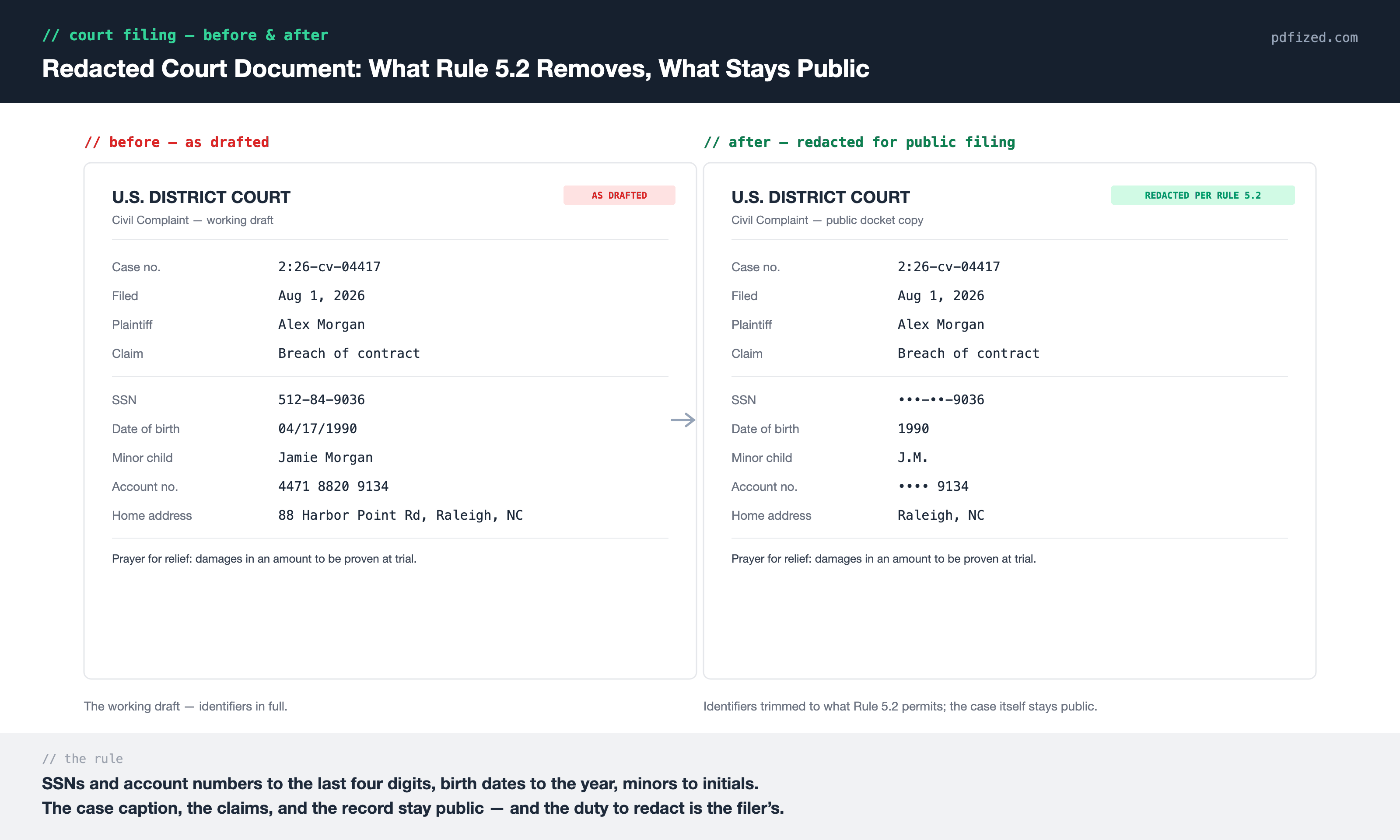
Redacted sections often appear as black bars, white gaps, or bracketed notes like [REDACTED]. Government releases, such as those under the Freedom of Information Act, frequently include a code beside each redaction indicating the exemption claimed. Don't assume a redaction means wrongdoing. In most cases it's routine privacy protection.
Can You Challenge a Redaction in Court?
Yes, in some situations. A party in litigation may ask the court to review redactions, especially for materials withheld in discovery on privilege grounds. Journalists and members of the public can also move to unseal or unredact court records, arguing that the public's interest in access outweighs the privacy interest. The outcome depends on the type of case and the reason for the redaction.
// faq
FAQ
Mostly to protect people who could get hurt if their names were public: children, witnesses, and informants. In federal filings, for example, a child's name is swapped for initials.
The filer does. Don't expect the court clerk to catch a stray Social Security number for you. If protected details slip through, the court can sanction the party or the attorney who filed them.
No. Redaction hides only parts of a document, and the rest stays public. Sealing locks away the whole document or case file, and it usually takes a court order.
Not in the way people often think. Most of the time it's plain privacy protection, like a Social Security number cut down to its last four digits.